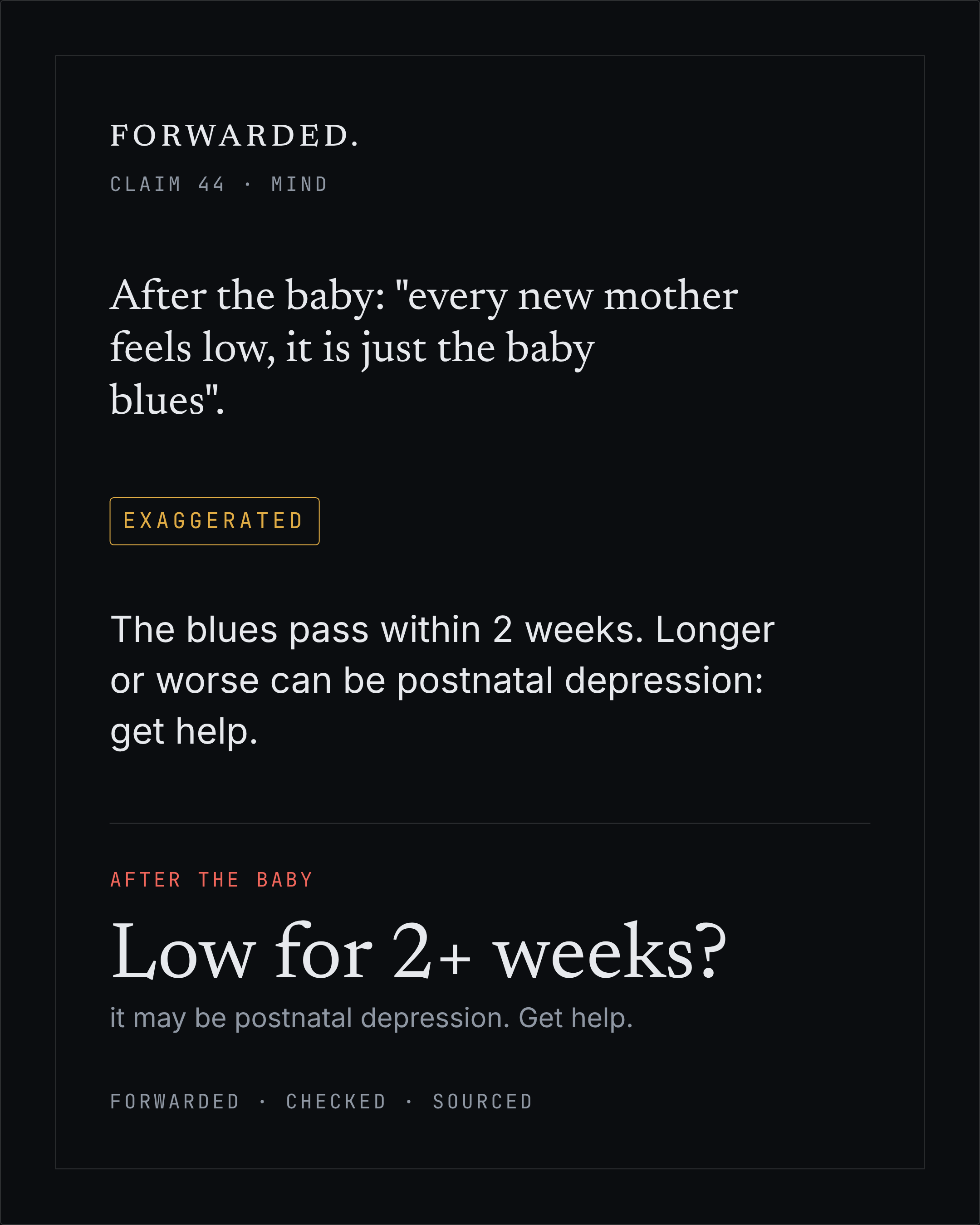
After the baby: "every new mother feels low, it is just the baby blues".
Published
Verdict
Feeling down, anxious or tearful for a few days after birth is common and usually passes within 2 weeks, but low mood that lasts longer, gets worse or starts later can be postnatal depression, a common condition that usually gets better with treatment.
As forwarded
"Every new mother cries for a few weeks. It is just baby blues, she will be fine. Don't make it a big issue."
Common family advice. Specific Indian version with URL and reach: not available. Reach not available
What the evidence says
Feeling down, anxious or irritable for a few days after a baby is born is very common. This is the baby blues, and it usually goes away within 2 weeks of the birth. [S1]
Postnatal depression is a common condition. Signs include low mood, finding it hard to enjoy anything, feeling hopeless or unable to cope, feeling guilty or like a bad parent, constant worry, poor sleep even when there is time to rest, difficulty bonding with the baby, and thoughts of harming oneself or the baby. [S1]
It can begin during pregnancy, soon after birth, or up to a year after the baby is born. Fathers and partners can also have depression after a baby arrives. [S1]
Treatment includes talking therapies such as CBT, and antidepressants; many antidepressants are safe while breastfeeding. Postnatal depression usually gets better in 3 to 6 months, and is more likely to get better with treatment. [S1]
How this verdict was reached
-
The forward
Taken exactly as it circulates, not as a summary of it.
-
The evidence
2 sources from the four tiers, strongest first.
- Tier 2 · 2
-
The line
Nothing below tier 4 is counted; every source here is graded.
-
The verdict
Exaggerated Every evidence sentence above links to its source. Not reviewed by a doctor; a sourced guide, not medical advice.
What to do instead
If low mood, worry or tearfulness lasts more than 2 weeks after the birth, gets worse, or starts later in the first year, tell a doctor, nurse or ASHA worker. [S1]
Family can help with practical things like cooking, chores and night feeds so she can rest. [S1]
Free, confidential support in Indian languages, 24 hours a day: call Tele-MANAS on 14416 or 1-800-891-4416. [S2]
If she talks about harming herself or the baby, get help the same day: call 112 or go to the nearest hospital. [S1]
Share card
Sources
- S1
- S2Ministry of Health and Family Welfare, Government of India. Tele MANAS: national tele mental health helpline.Tier 2 government service
telemanas.mohfw.gov.in/home
Tiers are as graded in the research file; where the file left a source ungraded, the editor graded it against the four tiers. "Circulation only" sources document that a claim circulates and are never cited as evidence. Where a primary paper could not be opened, the page says so in the Honest note.
Reviewed by
Every evidence sentence on this page traces to the public-health and medical sources listed above, but no doctor has reviewed or signed off this page. It is a sourced guide, not medical advice, and it does not replace a doctor. For any symptom, see a doctor; in an emergency, call 108 or 112.
Are you a registered doctor? You can review this page for free. Write to [email protected] with your name and medical council registration number, and you will get a link to a simple review page (sign-in is a one-time code sent to your email). Once the registration is verified, and with your consent, your name, registration number and review date appear on the pages you reviewed, and any correction you raise is made and dated on the page.
Corrections
No corrections yet. Write to [email protected].
Your reaction
Something wrong or unclear?
These reports are not shown on the page. Every one is read; fixes are dated under Corrections. To explain, write to us.
Reactions show how readers felt, not whether the page is right: the evidence above decides that. Counted only as totals for this page, with no identifier and no cookie; a number appears once it reaches 10.