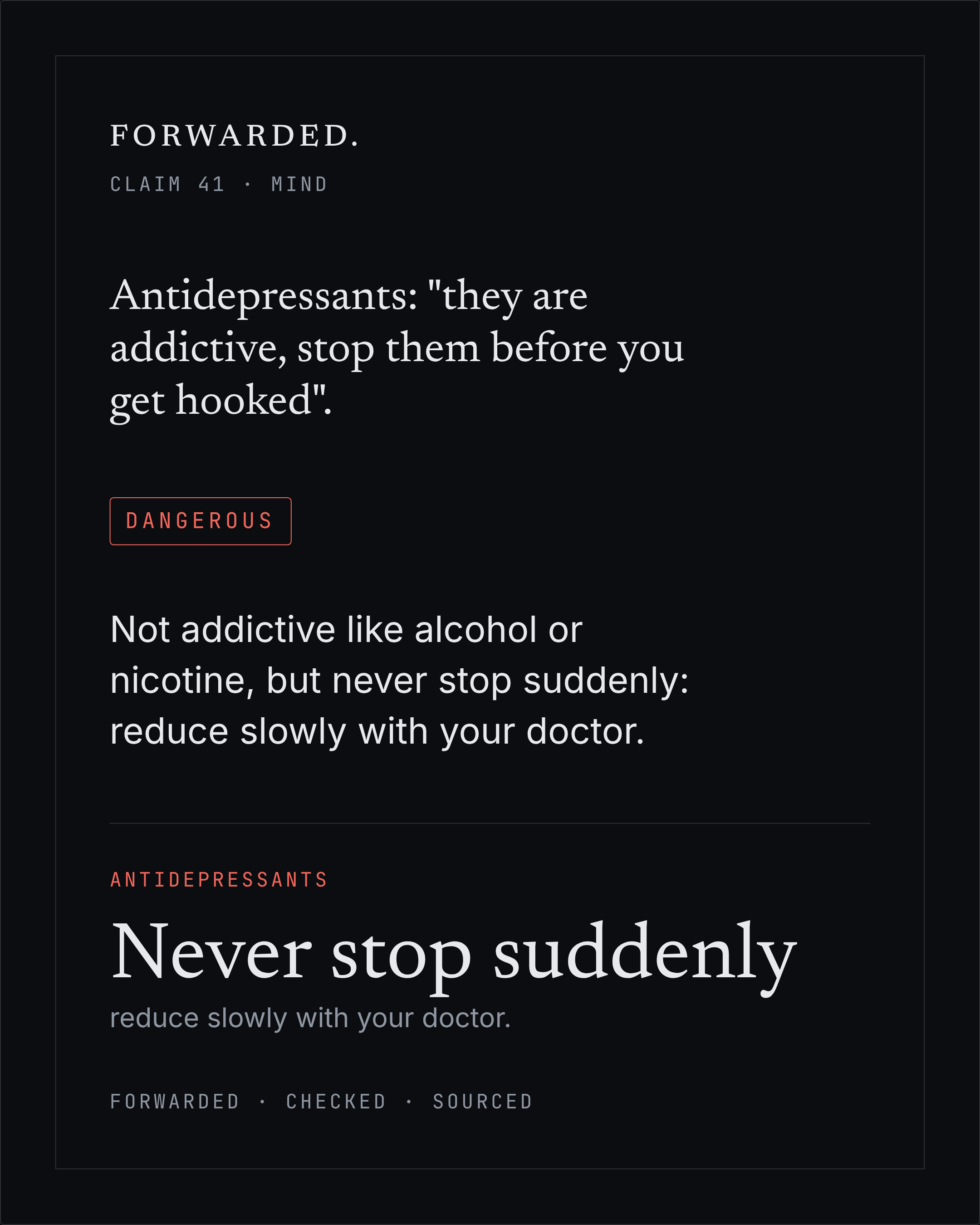
Antidepressants: "they are addictive, stop them before you get hooked".
Published
Verdict
Antidepressants do not cause the craving, loss of control or "high" that define addiction, but the body adapts to them, so stopping suddenly can cause withdrawal symptoms; the safe way off is a gradual plan agreed with your doctor.
As forwarded
"Antidepressants are addictive drugs. Once you start you can never stop. Throw them away today."
Circulates as text and short videos. Specific Indian version with URL and reach: not available. Reach not available
What the evidence says
The Royal College of Psychiatrists explains that addiction generally means an urge or craving for a substance, losing control over its use, and getting pleasure or a "high" from it, as can happen with alcohol, nicotine and benzodiazepines. [S1]
With antidepressants, stopping can be hard, but the College says this is more accurately described as physical dependence: the body adapts to the medicine and "misses" it when it is gone, which causes withdrawal effects. A drug does not need to produce a high to cause dependence. [S1]
Withdrawal symptoms can include headaches, dizziness, feeling sick, sleep problems, anxiety, low mood and "brain zaps". They usually last a few weeks, but for some people they are severe and last months or longer, more often after longer use or higher doses. [S2]
Stopping suddenly is the danger. The NHS advises never to stop an antidepressant suddenly or without talking to your doctor, who will plan a gradual reduction, usually over several weeks or months. Some withdrawal symptoms can feel like the illness coming back. [S2]
Antidepressants usually take 1 to 2 weeks to start working and up to 8 weeks to work fully, and are usually continued for at least 6 months after you feel better. [S2]
How this verdict was reached
-
The forward
Taken exactly as it circulates, not as a summary of it.
-
The evidence
3 sources from the four tiers, strongest first.
- Tier 2 · 3
-
The line
Nothing below tier 4 is counted; every source here is graded.
-
The verdict
Dangerous Every evidence sentence above links to its source. Not reviewed by a doctor; a sourced guide, not medical advice.
What to do instead
Do not stop an antidepressant suddenly. Ask the doctor who prescribed it for a plan to reduce the dose gradually. [S2][S1]
If side effects are hard to manage, or the medicine does not seem to help, tell your doctor: there are other options. [S2]
If you have thoughts of harming yourself after starting or changing an antidepressant, speak to a doctor straight away. Free, confidential support in Indian languages, 24 hours a day: call Tele-MANAS on 14416 or 1-800-891-4416. [S2][S3]
If someone is in immediate danger, call 112.
Share card
Sources
- S1Royal College of Psychiatrists. Stopping antidepressants (patient information; reflects NICE guidance on depression in adults).Tier 2 professional body
rcpsych.ac.uk/mental-health/treatments-and-wellbeing/stopping-antidepressants - S2
- S3Ministry of Health and Family Welfare, Government of India. Tele MANAS: national tele mental health helpline.Tier 2 government service
telemanas.mohfw.gov.in/home
Tiers are as graded in the research file; where the file left a source ungraded, the editor graded it against the four tiers. "Circulation only" sources document that a claim circulates and are never cited as evidence. Where a primary paper could not be opened, the page says so in the Honest note.
Reviewed by
Every evidence sentence on this page traces to the public-health and medical sources listed above, but no doctor has reviewed or signed off this page. It is a sourced guide, not medical advice, and it does not replace a doctor. For any symptom, see a doctor; in an emergency, call 108 or 112.
Are you a registered doctor? You can review this page for free. Write to [email protected] with your name and medical council registration number, and you will get a link to a simple review page (sign-in is a one-time code sent to your email). Once the registration is verified, and with your consent, your name, registration number and review date appear on the pages you reviewed, and any correction you raise is made and dated on the page.
Corrections
No corrections yet. Write to [email protected].
Your reaction
Something wrong or unclear?
These reports are not shown on the page. Every one is read; fixes are dated under Corrections. To explain, write to us.
Reactions show how readers felt, not whether the page is right: the evidence above decides that. Counted only as totals for this page, with no identifier and no cookie; a number appears once it reaches 10.