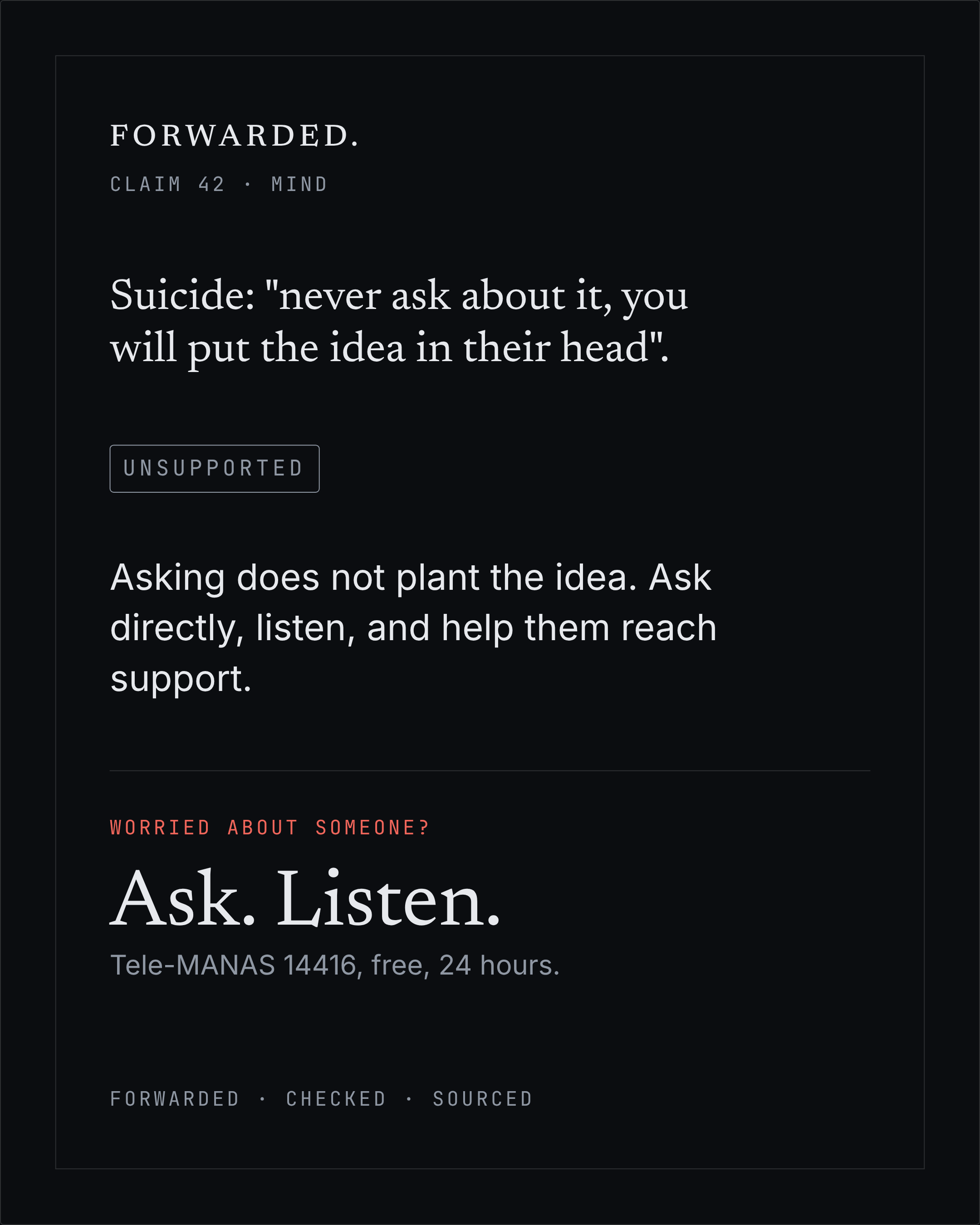
Suicide: "never ask about it, you will put the idea in their head".
Published
Verdict
Studies that asked people directly about suicidal thoughts found no increase in those thoughts, and talking about it may even reduce them; asking openly and listening is one of the most useful things a worried friend or relative can do.
As forwarded
"Never talk about suicide with someone who is low. You will give them ideas."
A widely held belief rather than a single viral forward. Specific Indian version with URL and reach: not available. Reach not available
What the evidence says
A review of 13 studies published from 2001 to 2013, in adults and adolescents and in both general and at-risk groups, found none showing a statistically significant rise in suicidal thoughts among people who were asked about them. It suggested that acknowledging and talking about suicide may reduce rather than increase such thoughts. [S1]
A meta-analysis of 13 prospective studies found no harmful effect of asking people about suicide, and concluded that its findings should allay fears that asking is harmful. [S2]
WHO says stigma and taboo stop many people who are thinking about suicide from seeking help, and that breaking down the taboo is important for prevention. [S3]
Suicide is preventable. Among WHO's key recommended measures is early identification, assessment and follow-up of anyone affected by suicidal thoughts or behaviour. [S3]
How this verdict was reached
-
The forward
Taken exactly as it circulates, not as a summary of it.
-
The evidence
4 sources from the four tiers, strongest first.
- Tier 1 · 1
- Tier 2 · 3
-
The line
Nothing below tier 4 is counted; every source here is graded.
-
The verdict
Unsupported Every evidence sentence above links to its source. Not reviewed by a doctor; a sourced guide, not medical advice.
What to do instead
If you are worried about someone, ask them directly whether they are thinking about suicide, and listen without judging. Asking does not put the idea in their head. [S1][S2]
Stay with them and help them call Tele-MANAS on 14416 (free, 24 hours, in Indian languages) or see a doctor. [S4]
If someone is in immediate danger, call 112 and do not leave them alone.
If you are having these thoughts yourself, you do not have to face them alone. Free, confidential support in Indian languages, 24 hours a day: call Tele-MANAS on 14416 or 1-800-891-4416. Or tell someone you trust today. [S4]
Share card
Sources
- S1Dazzi T, Gribble R, Wessely S, Fear NT. Does asking about suicide and related behaviours induce suicidal ideation? What is the evidence? Psychological Medicine 2014;44:3361-3363.Tier 2 (editorial review of 13 studies)
pubmed.ncbi.nlm.nih.gov/24998511 - S2DeCou CR, Schumann ME. On the iatrogenic risk of assessing suicidality: a meta-analysis. Suicide and Life-Threatening Behavior 2018;48(5):531-543.Tier 1
pubmed.ncbi.nlm.nih.gov/28678380 - S3
- S4Ministry of Health and Family Welfare, Government of India. Tele MANAS: national tele mental health helpline.Tier 2 government service
telemanas.mohfw.gov.in/home
Tiers are as graded in the research file; where the file left a source ungraded, the editor graded it against the four tiers. "Circulation only" sources document that a claim circulates and are never cited as evidence. Where a primary paper could not be opened, the page says so in the Honest note.
Reviewed by
Every evidence sentence on this page traces to the public-health and medical sources listed above, but no doctor has reviewed or signed off this page. It is a sourced guide, not medical advice, and it does not replace a doctor. For any symptom, see a doctor; in an emergency, call 108 or 112.
Are you a registered doctor? You can review this page for free. Write to [email protected] with your name and medical council registration number, and you will get a link to a simple review page (sign-in is a one-time code sent to your email). Once the registration is verified, and with your consent, your name, registration number and review date appear on the pages you reviewed, and any correction you raise is made and dated on the page.
Corrections
No corrections yet. Write to [email protected].
Your reaction
Something wrong or unclear?
These reports are not shown on the page. Every one is read; fixes are dated under Corrections. To explain, write to us.
Reactions show how readers felt, not whether the page is right: the evidence above decides that. Counted only as totals for this page, with no identifier and no cookie; a number appears once it reaches 10.