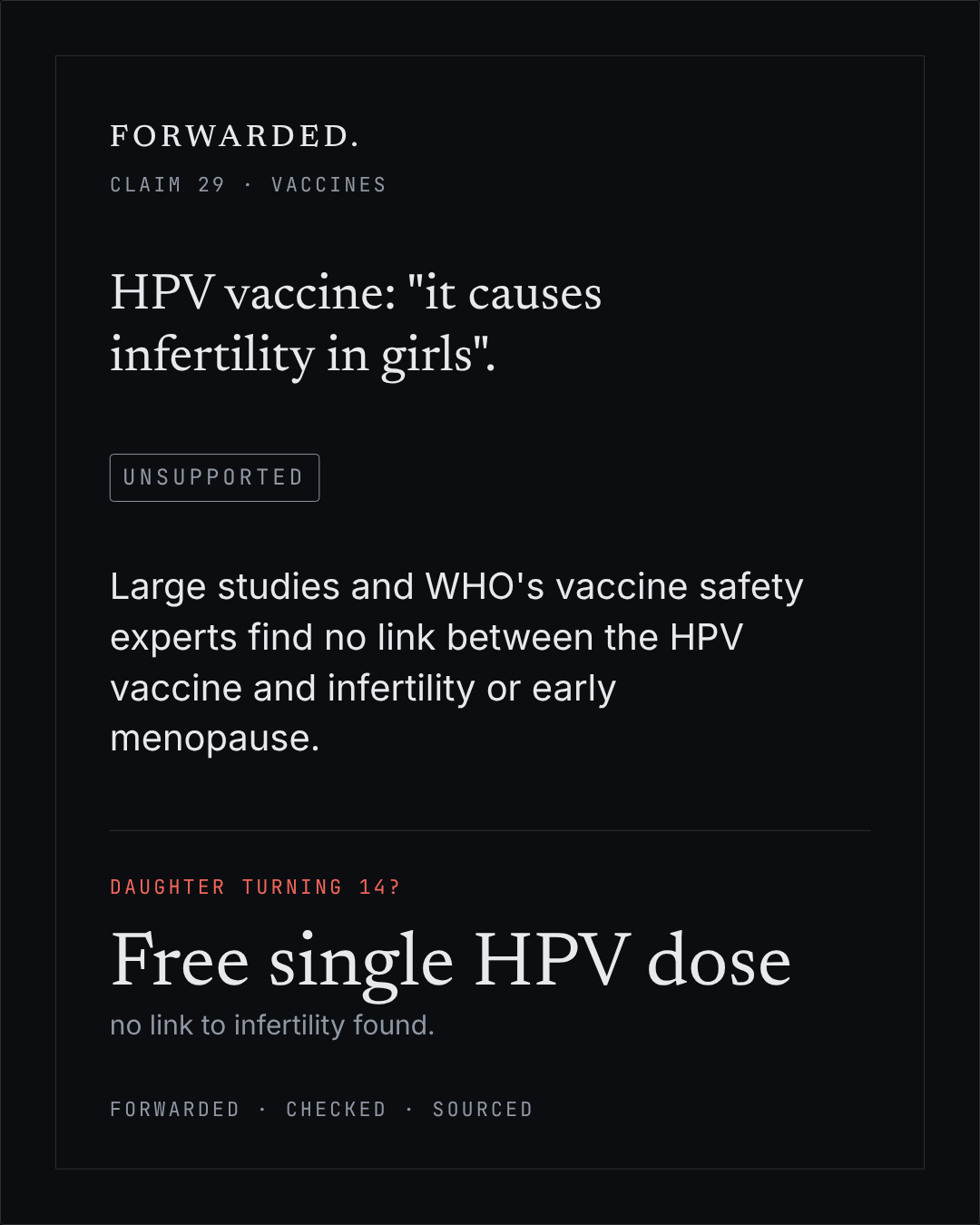
HPV vaccine: "it causes infertility in girls".
As forwarded
"The HPV vaccine causes infertility in girls." Variants say it causes early menopause (ovarian failure), that it causes cervical cancer and Down syndrome in future babies, that girls died in the earlier trial, or that it is a population-control plan.
Resurged with India's national HPV campaign. A February 2024 post on X claimed the vaccine has "a deadly side-effect of causing cervical cancer along with infertility" and that children born to vaccinated women have a higher risk of Down syndrome; a fact check rated it false, citing CDC ("There is no current evidence that HPV vaccines cause reproductive problems in women") and WHO's vaccine safety committee [S1]. A policy analysis reports that the 2026 national campaign "triggered renewed social media opposition", in which a 2013 parliamentary report on a 2009 demonstration project was widely recirculated and the rollout framed as a repeat experiment [S2]. Reach figures: not available. Reach not available
Verdict
Studies of millions of girls and women, and WHO's vaccine safety experts, find no link between the HPV vaccine and infertility or early menopause. The vaccine prevents infection with the virus that causes almost all cervical cancer, a disease that kills about 80,000 women in India every year; by preventing infections that can damage fertility, it may protect it.
What the evidence says
The real history behind the mistrust. In 2009, an HPV vaccine "demonstration project" vaccinated about 23,000 girls aged 10–14, many living in government hostels; it was suspended in 2010 after seven girls died. India's 72nd Parliamentary Standing Committee report (2013) found consent forms "incomplete and inaccurate", hostel wardens signing on behalf of parents in one state, and no rigorous monitoring of adverse events. [S8] A government inquiry concluded that none of the deaths was likely caused by the vaccine; recorded causes included drowning, snakebite, poisoning and malaria. [S2] The failure was in how consent and safety monitoring were handled, and it was real and serious. It is not evidence that the vaccine causes infertility, and none of the sources opened links that episode to infertility.
What is right: families should expect consent and monitoring. Families are right to expect proper consent and monitoring; the 2026 programme's 30-minute observation period and its medical officer for adverse events at each site exist for that reason. [S6]
WHO's vaccine safety experts. WHO's Global Advisory Committee on Vaccine Safety reviewed a systematic search (608 articles; 9 relevant studies on ovarian failure and ability to conceive, plus surveillance data from Australia, Europe and the USA, and three animal studies) and concluded that "the available data do not support an association between HPV vaccination and infertility or POI" (primary ovarian insufficiency) and "the evidence does not suggest a causal relationship between HPV vaccination and infertility". Six case reports of ovarian insufficiency 8–24 months after a first dose showed a time link but no evidence of causation, and a US study suggesting a link with pregnancy history was retracted by its journal for serious flaws in its analysis. [S3]
A national cohort. A Danish nationwide study of 996,300 girls and women aged 11–34 (2007–2016; 505,829 vaccinated) found no difference in primary ovarian insufficiency between vaccinated and unvaccinated (adjusted HR 0.96, 95% CI 0.55–1.68). [S4]
Safety and benefit in trials. A Cochrane review of 26 randomised trials (73,428 participants) found serious adverse events were the same in vaccine and control groups (669 vs 656 per 10,000; RR 0.98, 0.92–1.05; high certainty); miscarriage (RR 0.88, 0.68–1.14) and termination (RR 0.90, 0.80–1.02) did not differ (high certainty); and in girls and young women aged 15–26 without HPV at the start, high-grade precancer (CIN2+) fell from 164 to 2 per 10,000 (high certainty). [S5]
India's programme and stakes. Cervical cancer is the second most common cancer in Indian women, with over 1,20,000 new cases and nearly 80,000 deaths a year, and India accounts for 25% of global cervical cancer deaths. The national campaign launched on 28 February 2026 offers a single free dose to about 1.15 crore girls aged 14 at government facilities, with 30 minutes' observation afterwards, a medical officer for adverse events at each site, and exclusions for serious illness, pregnancy and past severe vaccine allergy. [S6]
What to do instead
If a girl feels unwell after vaccination, tell the on-site medical officer at once; every session site has one. In an emergency, call 108 or 112. [S6]
Have girls eat before the vaccine and stay for 30 minutes afterwards. [S6]
Get the free single dose at 14 through the government programme, and tell the health worker about any past severe allergy, current illness or pregnancy. [S6]
Families have a right to clear information and to sign consent themselves; ask questions before vaccination. [S8]
Share card
Sources
- S1NewsMeter. Does HPV vaccine for cervical cancer cause infertility?Circulation only; not evidence
newsmeter.in/fact-check/does-hpv-vaccine-for-cervical-cancer-cause-infertility-724394 - S2Kurian OC. The long afterlife of a regulatory failure: India, HPV and vaccine hesitancy. Observer Research Foundation.Context only; not evidence
orfonline.org/expert-speak/the-long-afterlife-of-a-regulatory-failure-india-hpv-and-vaccine-hesitancy - S3WHO Global Advisory Committee on Vaccine Safety. Human papillomavirus vaccines and infertility.Tier 2
who.int/groups/global-advisory-committee-on-vaccine-safety/topics/human-papillomavirus-vaccines/infertility - S4Hviid A, Myrup Thiesson E. HPV vaccination and primary ovarian insufficiency. JAMA Network Open 2021;4(8):e2120391 (Oncology Nursing News summary).Tier 3
oncnursingnews.com/view/analysis-shows-hpv-vaccine-not-associated-with-infertility-in-women - S5Arbyn M et al. Prophylactic vaccination against human papillomaviruses to prevent cervical cancer and its precursors. Cochrane CD009069.Tier 1
cochranelibrary.com/cdsr/doi/10.1002/14651858.CD009069.pub3/pdf/CDSR/CD009069/CD009069_abstract.pdf - S6PIB Research Unit / Ministry of Health and Family Welfare. National HPV vaccination campaign document.Tier 2
static.pib.gov.in/WriteReadData/specificdocs/documents/2026/feb/doc2026228807201.pdf - S7World Health Organization. Human papillomavirus vaccines: WHO position paper, December 2022.Tier 2
who.int/publications/i/item/who-wer9750-645-672 - S8Sarojini N, Deepa V. Trials and tribulations: an exposé of the HPV vaccine trials by the 72nd Parliamentary Standing Committee report. Indian Journal of Medical Ethics.Context; summary of a parliamentary report (not opened)
ijme.in/articles/trials-and-tribulations-an-expose-of-the-hpv-vaccine-trials-by-the-72nd-parliamentary-standing-committee-report/?galley=html
Tiers are as graded in the research file. "Circulation only" sources document that a claim circulates and are never cited as evidence. Where a primary paper could not be opened, the page says so in the Honest note.
Reviewed by
Every evidence sentence on this page traces to the sources listed above, but no registered physician has yet signed it off. When one has, their name, registration number and date of review will appear here. Until then, read this page as a sourced guide, not as medical advice: for any symptom, call 108 or 112, or see a doctor.
Corrections
No corrections yet. Write to [email protected].
Was this page helpful?
Counted only as a total for this page; no identifier, no cookie. Something wrong or unclear? Write to us.