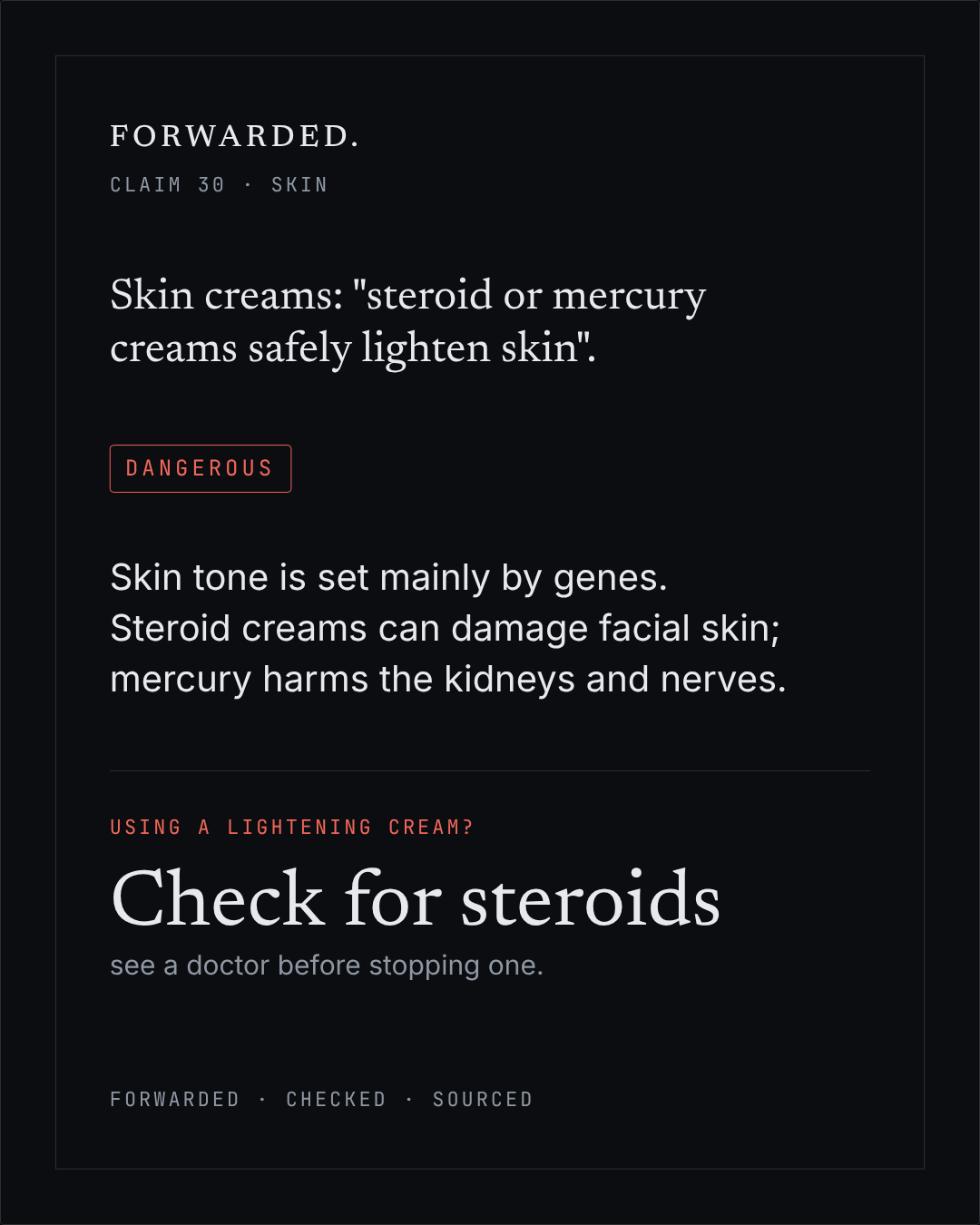
Skin creams: "steroid or mercury creams safely lighten skin".
As forwarded
"Steroid or mercury fairness creams are a safe way to lighten skin." Variants: "a cheap cream from the chemist works in a week"; "mix this ointment into your face cream"; "imported whitening creams and soaps are stronger and safe".
Mostly a market and word-of-mouth practice rather than one viral text. In a study at 12 dermatology centres across India, 433 of 2,926 people (14.8%) seen for facial skin problems were using steroid creams on the face; use as a lightening cream (grouped with aftershave use) was the commonest reason (29%); 59.3% used them on a non-doctor's recommendation, and 90.3% of those recommendations were for potent or super-potent steroids [S1]. At a tertiary hospital, 271 of 748 people with facial skin problems (36.2%) were using steroid creams, 27.3% of them to lighten skin; 39.9% bought them over the counter on a pharmacist's or shop owner's advice, and 83.8% did not know about side effects [S2]. A 2024 survey of dermatologists describes steroid-damaged facial skin as "virtually an epidemic in India" [S3]. These are clinic-based studies; no population figure was located. Practice documented
Verdict
Skin tone is set mainly by your genes, and no cream safely changes it. Creams that seem to work fast often contain a strong steroid, which can thin the skin, cause acne, redness, visible blood vessels, patchy colour and unwanted hair, and make the face burn and flare when you stop. Mercury in creams or soaps can damage the kidneys and nerves. If you are using such a product, see a doctor before stopping a strong steroid.
What the evidence says
What is right: the change is real, at first. Steroid creams often do make skin look lighter and smoother at first, because strong steroids suppress inflammation and pigment and thin the skin. That early effect is exactly why people continue; the damage appears later, on average about five months after starting. [S2][S7]
Skin tone is set mainly by genes. Skin colour depends on how much and which type of melanin a person's cells make; everyone has about the same number of pigment cells, and the amount of melanin depends on genetics and ancestry; sun exposure raises melanin temporarily; and products claiming to change melanin lack supporting research. [S5] A genome study of 2,092 people found several gene regions with a likely role in skin tone, showing that many genes contribute. [S6] There is no medical reason to change healthy skin tone.
Steroids on the face cause harm. In the multicentre Indian study, 90.5% of people using steroids on the face had side effects, most often acne or worsening acne. [S1] In the hospital study, the commonest was rosacea-like redness with sun sensitivity (29.2%), followed by comedonal acne or acne flares (25.1%). [S2] The NHS says to check with a pharmacist or doctor before using even mild hydrocortisone on the face because "it can damage the skin in these areas". Side effects include thinning of the skin, stretch marks, changes in skin colour, small red blood vessels and excess hair growth, more likely with strong types, large areas or long use; it should not be used for more than 7 days without advice; and stopping long-term use suddenly "can cause a withdrawal reaction" with redness, burning, intense itching, peeling and oozing. [S7] Creams sold to lighten skin often contain far stronger steroids than hydrocortisone, and detecting hidden steroids in them is itself a research topic in India. [S1][S4]
Mercury. WHO says mercury-containing skin-lightening products are "hazardous to health and as a result have been banned in many countries", names hydroquinone as another hazardous ingredient, and notes banned products are still sold online. [S8] PAHO/WHO: mercury in skin-lightening soaps and creams "can cause kidney damage", skin rashes, discolouration and scarring, and reduced resistance to bacterial and fungal skin infections. [S9] A CDC report describes a woman who used an imported lightening cream on her face twice daily for about seven years; it contained 12,000 ppm mercury, apparently as methylmercury. She developed numbness, slurred speech, blurred vision, unsteady walking and delirium, and despite treatment to remove the mercury remained unable to speak coherently or care for herself; a family member was also exposed. [S10]
The rules in India. Mercury salts are prohibited in cosmetics other than as limited eye-area preservatives, so any mercury in a skin cream is unlawful. [S11] In March 2018 the Union Health Ministry placed 14 steroid creams and ointments under Schedule H (prescription only), following a Drugs Technical Advisory Board recommendation, to stop their sale without prescription. [S12]
What to do instead
Numbness, slurred speech, unsteady walking or confusion in someone using imported creams: call 108 or 112. [S10]
If you have been using a strong steroid cream on your face for weeks or months, do not stop suddenly on your own; see a dermatologist, who can taper it and treat the flare. [S7]
Do not use a lightening cream that lists a steroid or does not list its ingredients; steroid creams in India need a prescription. [S12]
Avoid imported or unlabelled creams and soaps; mercury is banned in skin creams in India. [S8][S11]
Daily sunscreen and covering up protect skin of every tone. [S5]
Share card
Sources
- S1Multicentre study of topical corticosteroid abuse on the face among dermatology outpatients. IADVL journal (Medknow).Tier 3
utoronto.scholaris.ca/items/32e52b80-0437-474f-9c14-b8e80ec8ac2a - S2Topical steroid damaged/dependent face (TSDF): a study from a tertiary care hospital. Indian Journal of Dermatology.Tier 3
doaj.org/article/5877306bf99e4428ab7ef3e161a4ee21 - S3Prescribing patterns in topical steroid damaged face: a survey of dermatologists. Indian Dermatology Online Journal.Tier 3
doaj.org/article/4cbe574fcb5b4e0cba1062ac92b7851d - S4Detection of steroids in topical fairness preparations using histamine wheal test. Indian Dermatology Online Journal.Tier 3
doaj.org/article/3adc3994067e4e30910c92581d01501f - S5
- S6Crawford NG et al. Loci associated with skin pigmentation identified in African populations. Science 2017 (University of Pennsylvania release).Tier 3
eurekalert.org/news-releases/543946 - S7
- S8World Health Organization. Mercury in skin lightening products (information note).Tier 2
who.int/publications/i/item/mercury-in-skin-lightening-products - S9PAHO/WHO. Mercury in skin lightening soaps and creams.Tier 2
paho.org/en/news/1-6-2012-mercury-skin-lightening-soaps-and-creams - S10CDC. Notes from the field: methylmercury toxicity from a skin lightening cream. MMWR 2019;68(50).Tier 3
cdc.gov/mmwr/volumes/68/wr/mm6850a4.htm - S11Centre for Science and Environment. Fact sheet IV: mercury in cosmetics.Context only; NGO summary of the rules (primary rule not opened)
cseindia.org/fact-sheet-4-mercury-in-cosmetics-5284 - S12BioSpectrum India. Health Ministry bans OTC sale of 14 steroid creams.Circulation only; not evidence
biospectrumindia.com/news/22/10739/health-ministry-bans-otc-sale-of-14-steroid-creams.html
Tiers are as graded in the research file. "Circulation only" sources document that a claim circulates and are never cited as evidence. Where a primary paper could not be opened, the page says so in the Honest note.
Reviewed by
Every evidence sentence on this page traces to the sources listed above, but no registered physician has yet signed it off. When one has, their name, registration number and date of review will appear here. Until then, read this page as a sourced guide, not as medical advice: for any symptom, call 108 or 112, or see a doctor.
Corrections
No corrections yet. Write to [email protected].
Was this page helpful?
Counted only as a total for this page; no identifier, no cookie. Something wrong or unclear? Write to us.