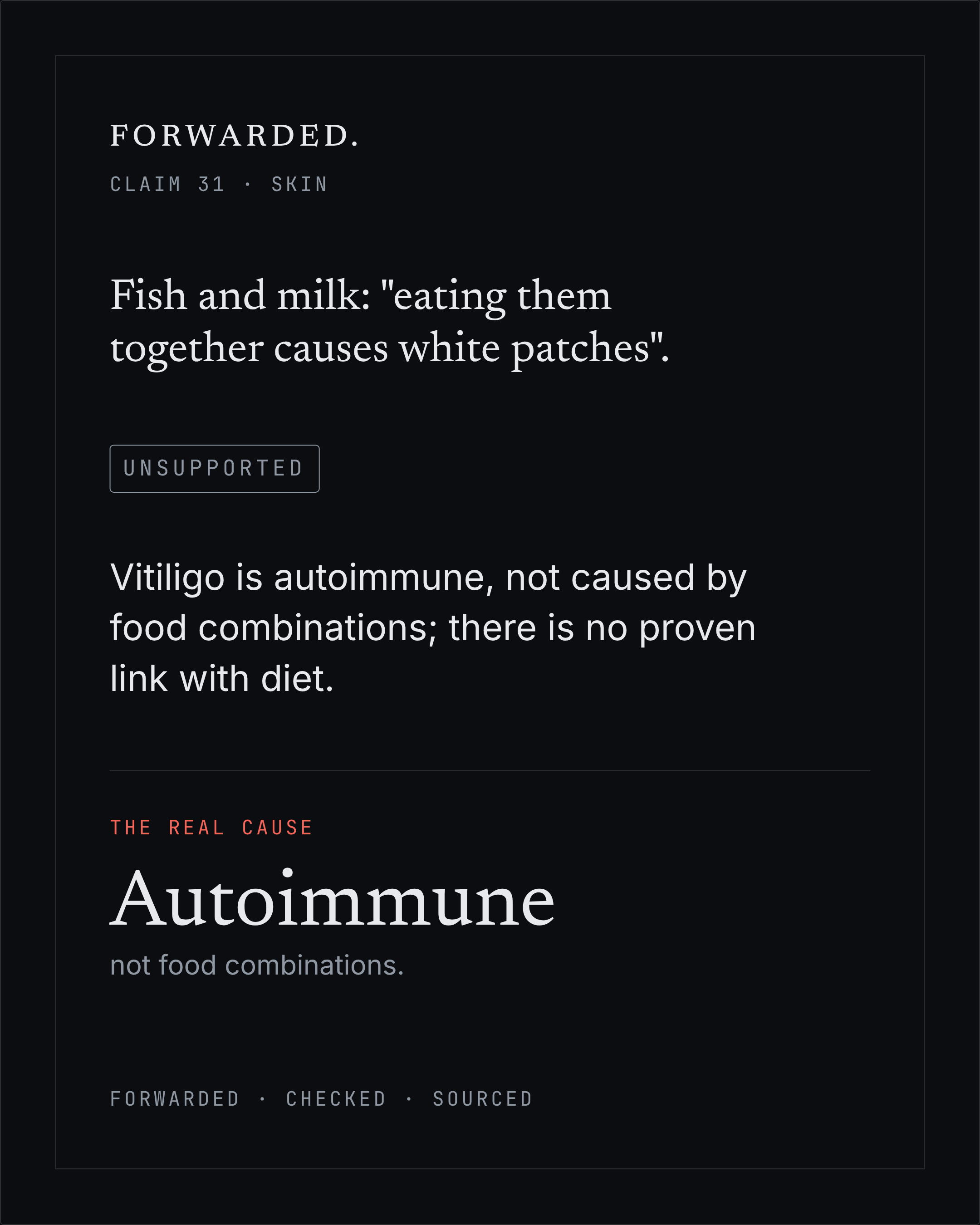
Fish and milk: "eating them together causes white patches".
As forwarded
"Never drink milk after eating fish. It causes white patches on the skin."
Common family advice repeated in forwards. Specific Indian version with URL and reach: not available. Reach not available
Verdict
Vitiligo happens when the immune system damages the skin's pigment cells; it is linked to genes and other autoimmune conditions, and dermatologists find no proven link with diet, so fish with milk does not cause it.
What the evidence says
Vitiligo happens when there are not enough working pigment cells (melanocytes) in the skin. The most common type is thought to be an autoimmune condition, where the immune system attacks those cells. [S1][S2]
How this verdict was reached
-
The forward
Taken exactly as it circulates, not as a summary of it.
-
The evidence
2 sources from the four tiers, strongest first.
- Tier 2 · 2
-
The line
Nothing below tier 4 is counted; every source here is graded.
-
The verdict
Unsupported Every evidence sentence above links to its source. Not reviewed by a doctor; a sourced guide, not medical advice.
What to do instead
If pale or white patches appear, see a doctor or dermatologist: some look-alike conditions are easily treated. [S1]
Ask about treatment options, which can include creams, light therapy and skin camouflage. [S1][S2]
Protect pale patches from the sun; they burn easily. [S2]
There is no need to avoid eating fish and milk together because of vitiligo.
Share card
Sources
- S1
- S2British Association of Dermatologists. Vitiligo patient information leaflet.Tier 2 professional body
skinhealthinfo.org.uk/wp-content/uploads/2018/11/Vitiligo-PIL-April-2026.pdf
Tiers are as graded in the research file; where the file left a source ungraded, the editor graded it against the four tiers. "Circulation only" sources document that a claim circulates and are never cited as evidence. Where a primary paper could not be opened, the page says so in the Honest note.
Reviewed by
Every evidence sentence on this page traces to the public-health and medical sources listed above, but no doctor has reviewed or signed off this page. It is a sourced guide, not medical advice, and it does not replace a doctor. For any symptom, see a doctor; in an emergency, call 108 or 112.
Are you a registered doctor? You can review this page for free. Write to [email protected] with your name and medical council registration number. Once the registration is verified, and with your consent, your name, registration number and review date appear on the pages you reviewed, and any correction you raise is made and dated on the page.
Corrections
No corrections yet. Write to [email protected].
Was this page helpful?
Counted only as a total for this page; no identifier, no cookie. Something wrong or unclear? Write to us.