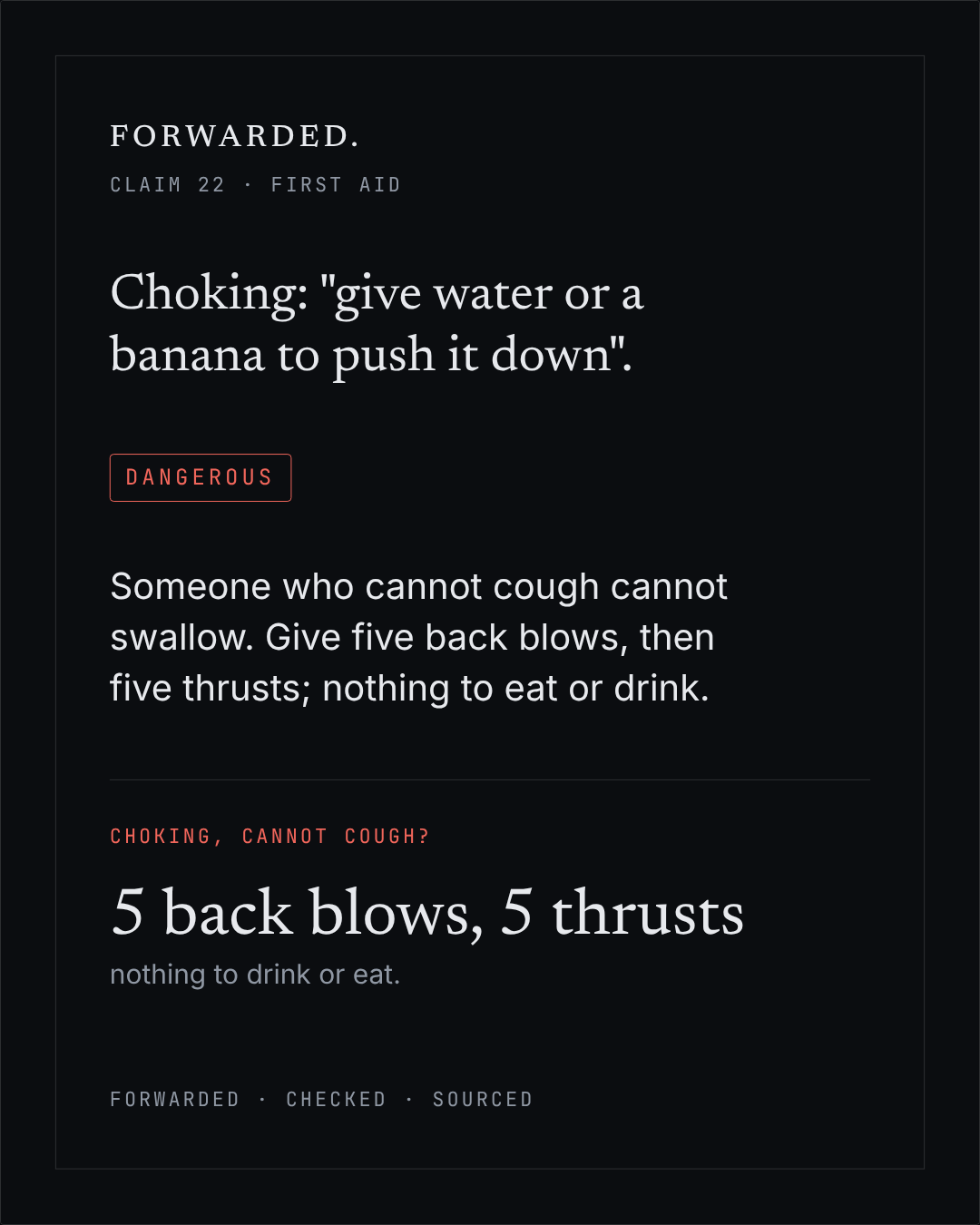
Choking: "give water or a banana to push it down".
As forwarded
"If someone is choking, give water or a banana to push it down." Variants: swallow a ball of rice or bread; drink water "to wash it down"; reach into the throat with a finger to hook it out; for a fish bone, swallow raw banana or rice.
A household instinct more than one viral text. The clearest documented Indian version is the fish-bone remedy: an ENT surgeon at a Mumbai public hospital, after removing a 2.8 cm fish bone, said one "should not swallow rice or raw banana to force down stuck fish bones" and should seek medical help instead [S1]. A news report on a toddler's choking death quotes paediatricians on high-risk foods for children under three and warns against putting a finger into the throat [S2]. A forward that specifically tells readers to give water or a banana to a choking person was not located. An Indian community-health editorial notes there is little Indian data on choking and no uniform public first-aid training programme [S3]. Reach figure: not available. Reach not available
Verdict
What the evidence says
What is right: a strong cough. A strong cough is the body's own best clearing mechanism, and the international resuscitation committee says to encourage it. The forward's error is adding something to swallow. [S4]
What works. The International Liaison Committee on Resuscitation (ILCOR) reviewed the evidence and recommends encouraging coughing first; back blows for a person with an ineffective cough; abdominal thrusts in adults and children over one when back blows fail (not in infants, because of concern about harm); removing an object only if it is visible in the mouth; no blind finger sweeps; chest compressions if the person becomes unconscious; and that bystanders act as soon as choking is recognised. All recommendations are weak and based on very low-certainty evidence (case series and case reports), because trials are not possible in choking. In the case series, abdominal thrusts relieved obstruction in 417 patients across six series, while 49 studies reported 52 cases of injury from them. [S4]
The sequence. Mayo Clinic: signs include hands clutched to the throat, inability to talk, strained or noisy breathing, a weak cough and blue or grey lips. If the person can cough forcefully, let them keep coughing; if not, give five back blows between the shoulder blades, then five abdominal thrusts, alternating until the object comes out. For pregnant people, or when you cannot reach around the stomach, use chest thrusts. For infants under one: five back blows face-down on the forearm with the head lower than the body, then five chest compressions with two fingers. If the person becomes unconscious, start CPR, and "Never finger sweep if you can't see the object". [S5] Neither ILCOR nor Mayo Clinic mentions water or food as a treatment. [S4][S5]
Water and food. A city government health commission's first-aid myth page says larger food stuck in the throat "could not be removed by drinking water", and that drinking can make things worse by triggering severe coughing and possible suffocation; swallowing bread or rice to push down a fish bone can drive it deeper or even pierce the gullet. [S6] No study measuring harm from giving water or food during choking was located; the guideline position is that the only effective actions are coughing, back blows and thrusts. [S4]
Two different problems. A complete airway blockage (cannot breathe, speak or cough) is an emergency measured in minutes. A fish bone or food stuck in the gullet, where the person can breathe and talk, is not an airway blockage, but swallowing food to force it down is still advised against; it needs a doctor. [S6]
What to do instead
Cannot breathe, speak or cough, or turning blue: act now, and have someone call 108 or 112. [S4][S5]
If they can cough forcefully, encourage them to keep coughing. Do not slap them or give anything to drink or eat. [S4][S5]
Adult or child over one who cannot cough: lean them forward and give up to five firm back blows between the shoulder blades with the heel of your hand. If that fails, give up to five abdominal thrusts (fist just above the navel, pull sharply inward and upward). Keep alternating. [S4][S5]
Pregnant, or you cannot reach around them: chest thrusts instead of abdominal thrusts. [S5]
Baby under one: face-down along your forearm, head lower than the body, five back blows; then turn face-up and give five chest thrusts with two fingers in the centre of the chest. Never abdominal thrusts on a baby. [S4][S5]
If they become unresponsive: lay them on the floor, call 112 or 108, start CPR, and remove an object only if you can see it; no blind finger sweeps. [S4][S5]
Fish bone stuck but breathing normally: do not swallow rice, bread or banana to force it down; see a doctor. [S6]
Share card
Sources
- S1Free Press Journal. KEM doctors remove 2.8 cm fish bone stuck in woman's throat.Circulation only; not evidence
freepressjournal.in/mumbai/miraculous-relief-for-magur-eater - S2The South First. Toddler chokes on murukku and dies; paediatricians warn parents (title shortened).Circulation only; not evidence
thesouthfirst.com/health/toddler-chokes-on-murukku-dies-in-kerala-paediatricians-warn-parents-choking - S3Kumar A et al. Choking – a public health problem: are we prepared? Indian Journal of Community Health 2019;31(2):284–286.Context only; not evidence
iapsmupuk.org/journal/index.php/IJCH/article/view/1086 - S4Couper K et al., ILCOR Basic Life Support and Paediatric Task Forces. Foreign body airway obstruction in adults and children: Consensus on Science with Treatment Recommendations.Tier 2 (systematic review by a guideline body)
costr.ilcor.org/document/removal-of-foreign-body-airway-obstruction-tfsr-costr - S5Mayo Clinic. Choking: first aid.Tier 4
mayoclinic.org/first-aid/first-aid-choking/basics/ART-20056637 - S6Beijing Municipal Health Commission. Weekly first-aid topic: misunderstandings of first-aid measures.Tier 4-equivalent government health page
wjw.beijing.gov.cn/English/HealthServices/HealthIndications/202011/t20201130_2153117.html - S7Healthy WA (Government of Western Australia). First aid for a choking adult or child over 1.Tier 4-equivalent government health page
health.wa.gov.au/sitecore/content/Healthy-WA/Articles/F_I/First-aid-for-a-choking-adult-or-child-over-1
Tiers are as graded in the research file. "Circulation only" sources document that a claim circulates and are never cited as evidence. Where a primary paper could not be opened, the page says so in the Honest note.
Reviewed by
Every evidence sentence on this page traces to the sources listed above, but no registered physician has yet signed it off. When one has, their name, registration number and date of review will appear here. Until then, read this page as a sourced guide, not as medical advice: for any symptom, call 108 or 112, or see a doctor.
Corrections
No corrections yet. Write to [email protected].
Was this page helpful?
Counted only as a total for this page; no identifier, no cookie. Something wrong or unclear? Write to us.