Drowning: "hang them upside down to drain the water".
As forwarded
"Hang a drowning victim upside down or roll them on a pot to drain the water." Variants: swing the person by the legs; press hard on the stomach to push water out; bury the body in salt "within two hours" to bring them back.
Documented as practice and as a social-media claim. A 2021 news report describes villagers who pulled a drowned man from a river, hung him upside down from a tree and swung him from side to side to revive him; he died [S1]. A 2022 report describes parents who covered their 10-year-old son, who had drowned in a pond, with more than 100 kg of salt for over four hours, after a villager said a social media post claimed salt applied within two hours could bring a person back to life; the attempt failed [S2]. The "roll on a pot" variant was not documented in a source opened for this research. Reach of a specific forward: not available. Practice documented
Verdict
A drowning person dies from lack of oxygen, not from a stomach full of water; most inhale only a little, and the body absorbs it. Hanging, swinging, rolling on a pot or pressing the stomach wastes the minutes in which CPR works. Get them out safely, call 112 or 108, and if they are not breathing normally, start CPR with rescue breaths at once.
What the evidence says
Why draining looks logical. Froth or water may come from the mouth, and vomiting is common during rescue, which makes "draining" seem sensible. The guidance is to keep the airway open and give CPR, not to hold the person upside down. [S4]
Little water, and draining it does not help. The American Red Cross Scientific Advisory Council found that "Only a modest amount of water is aspirated by the majority of drowning victims", that it is quickly absorbed into the circulation and does not block the windpipe, and that some victims inhale none. "Subdiaphragmatic abdominal thrusts are neither effective nor safe methods for attempting water removal"; "The routine use of abdominal thrusts for drowning victims is not recommended"; drowning victims should be managed like any other patient with airway, breathing or circulation problems. [S3] No guideline opened mentions hanging upside down or rolling on a pot; the guidance below is incompatible with both.
Breaths are the treatment. The 2024 American Heart Association and American Academy of Pediatrics update says anyone pulled from the water who is not breathing normally or not conscious should be presumed to be in cardiac arrest and given CPR with rescue breaths and chest compressions; compression-only CPR is a fallback for rescuers unable or unwilling to give breaths. An unconscious person removed from the water should be moved near-horizontal "with the head above body level and the airway open", and anyone who needed any resuscitation, even only rescue breaths, should go to hospital. [S4] Trained rescuers should start with two rescue breaths followed by 30 compressions. [S5] An update by AIIMS paediatricians for Indian doctors recommends "CPR, including rescue breathing, as soon as an unresponsive submersion victim is removed from the water". [S6]
The scale. About 300,000 people drown each year; 92% of drowning deaths occur in low- and middle-income countries; children under five account for nearly a quarter; and over half of the world's drowning occurs in the WHO Western Pacific and South-East Asia regions combined. [S7] National Crime Records Bureau data cited in the Indian Pediatrics update put drowning at 9.1% of accidental deaths in India. [S6]
What to do instead
Shout for help and call 112 or 108. Once the person is out of the water, if they are not breathing normally or not responding, start CPR straight away, with rescue breaths and chest compressions. If trained, give two breaths first, then 30 compressions; if you cannot give breaths, do compressions only until help arrives. [S4][S5]
Do not jump in unless you are trained and it is safe; reach or throw something that floats. [S7][S4]
Lay them flat on their back, head level with or slightly above the body. [S4]
Do not hang, swing, roll on a pot, press the stomach, or cover the body in salt; none removes the problem, and all delay CPR. [S3][S4]
Anyone who needed rescue breaths or CPR, or who coughs, is breathless or drowsy after being in the water, must go to hospital, even if they seem to recover. [S4]
Prevention: cover wells and water tanks, fence ponds near homes, and never leave young children alone near water, including buckets. [S7]
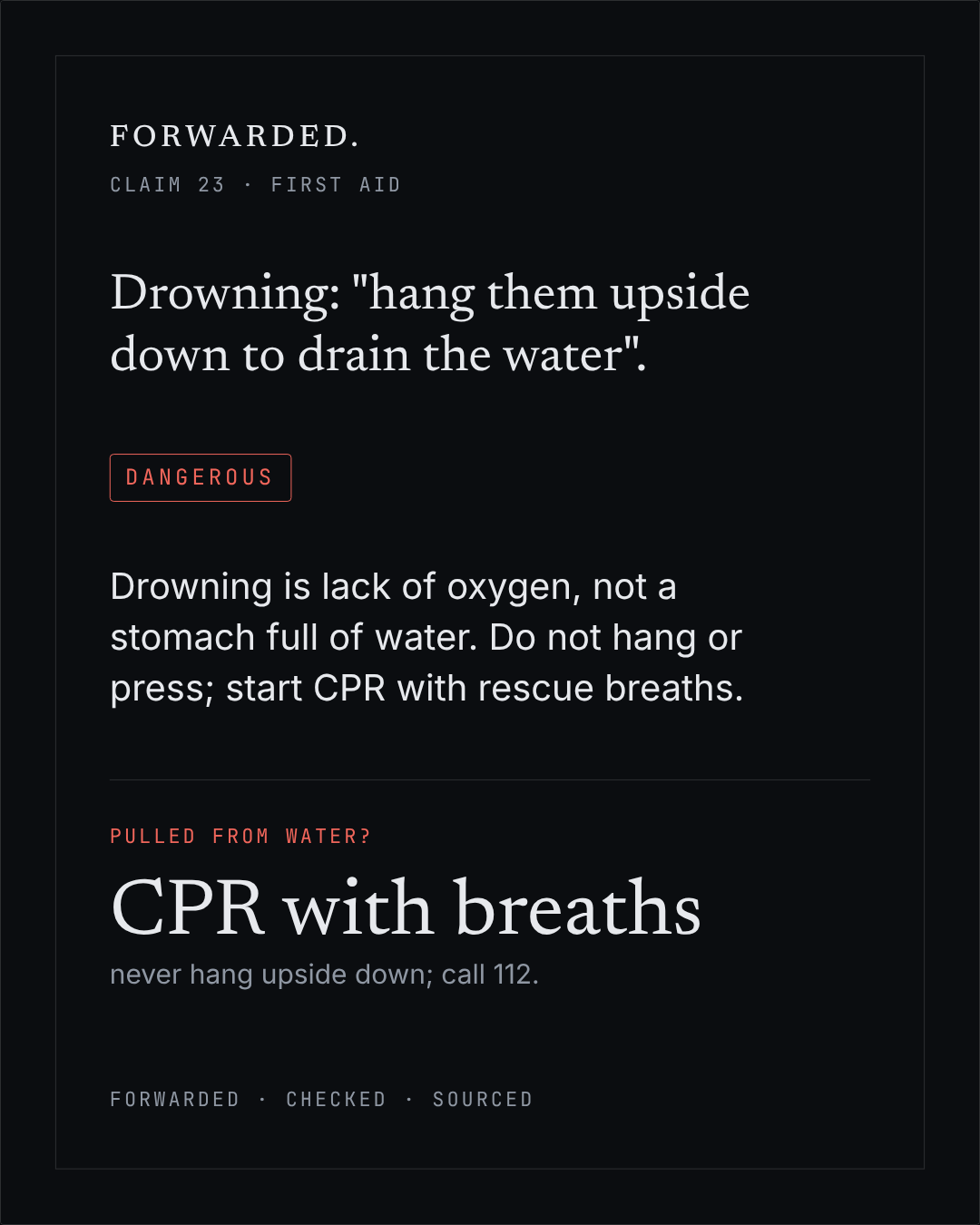
Share card
Sources
- S1The Quint. Villagers try to revive drowned man by hanging him on a tree.Circulation only; not evidence
thequint.com/neon/social-buzz/villagers-try-to-revive-drowned-man-by-hanging-him-on-tree-madhya-pradesh - S2Malay Mail (citing The Times of India). Parents attempt to revive dead son by covering his body in salt.Circulation only; not evidence
malaymail.com/news/life/2022/09/07/in-india-parents-attempt-to-revive-dead-son-by-covering-his-body-in-salt/27001 - S3American Red Cross Scientific Advisory Council. Advisory: drowning and abdominal thrusts.Tier 2
redcross.org/content/dam/redcross/Health-Safety-Services/scientific-advisory-council/Scientific Advisory Council ADVISORY - Drowning and Abdominal Thrusts.pdf - S4American Academy of Pediatrics (HealthyChildren.org). CPR for drowning: updated guidance.Tier 2 summary
healthychildren.org/English/news/Pages/cpr-for-drowning-updated-guidance.aspx - S5American Heart Association News. CPR with rescue breaths vital to resuscitation after drowning.Tier 2 summary
heart.org/en/news/2024/11/12/cpr-with-rescue-breaths-vital-to-resuscitation-after-drowning - S6Tripathy SK, Kumar A, Das S. Resuscitation following drowning: key updates from the AHA and AAP guidelines. Indian Pediatrics 2025;62:542–546.Tier 3 (narrative update)
indianpediatrics.net/july2025/542.pdf - S7
Tiers are as graded in the research file. "Circulation only" sources document that a claim circulates and are never cited as evidence. Where a primary paper could not be opened, the page says so in the Honest note.
Reviewed by
Every evidence sentence on this page traces to the sources listed above, but no registered physician has yet signed it off. When one has, their name, registration number and date of review will appear here. Until then, read this page as a sourced guide, not as medical advice: for any symptom, call 108 or 112, or see a doctor.
Corrections
No corrections yet. Write to [email protected].
Was this page helpful?
Counted only as a total for this page; no identifier, no cookie. Something wrong or unclear? Write to us.