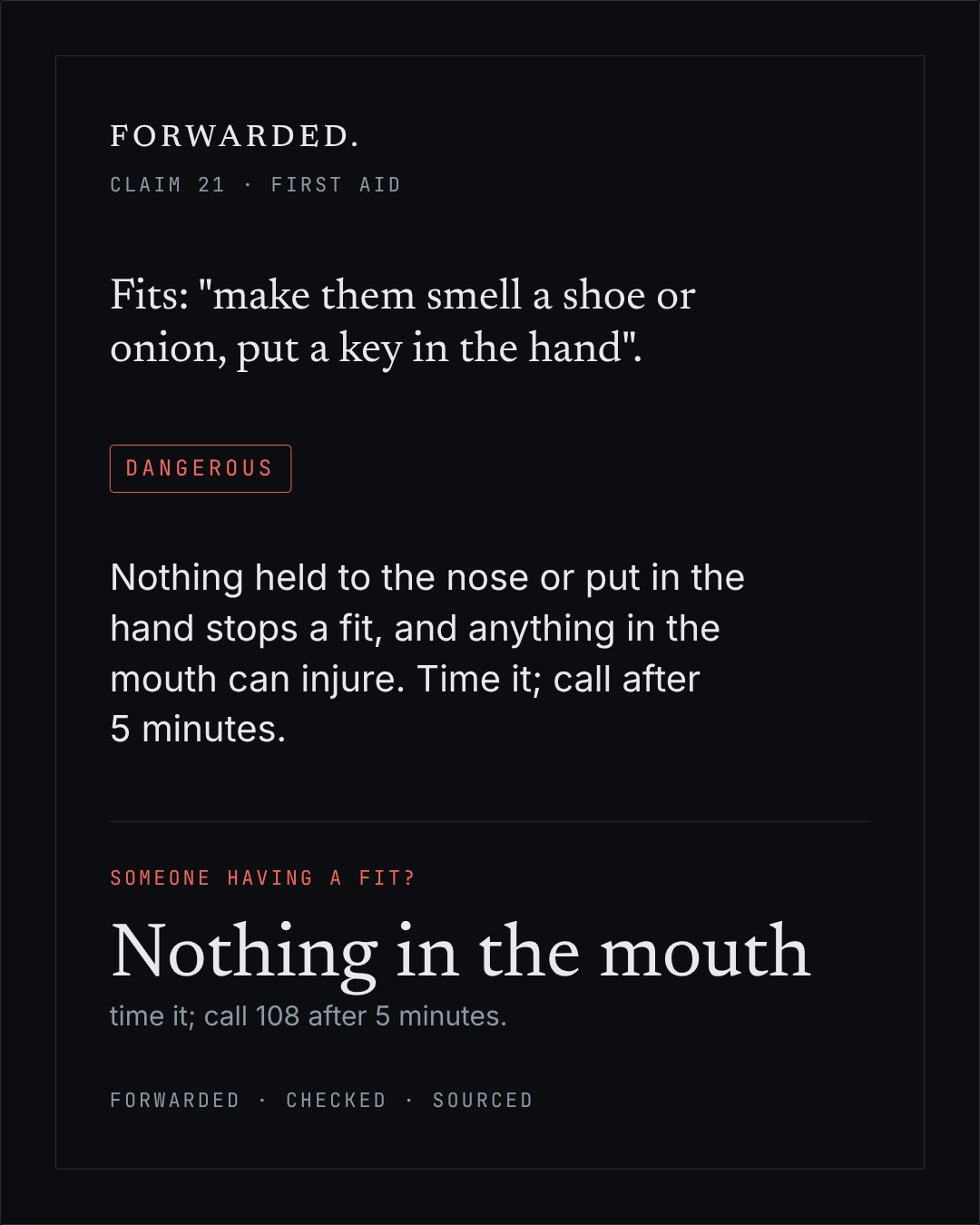
Fits: "make them smell a shoe or onion, put a key in the hand".
As forwarded
"During a fit, make them smell a shoe or onion, put a key in the hand, or put something in the mouth." Variants: an iron or metal object pressed into the hand; a spoon or cloth forced between the teeth "so they don't swallow the tongue"; water sprinkled or thrown on the face; holding the person down.
Mostly a household practice rather than one viral text, but strikingly common. In a survey of 798 urban secondary-school students in one district (April 2010), 22.69% said they would make the person smell a shoe or an onion and 23.43% would throw water on them; about 51.5% would take the person to hospital [S1]. In a survey of 9,440 people with epilepsy in 56 rural districts (2012–2018), 50.94% thought making a person smell onion or shoes would help during a seizure [S2]. A patient-community explainer with a neurologist lists sniffing onion, a shoe or a metal object, and forcing an object into the mouth, as common myths [S3]. The "key in the hand" variant itself was not documented in a source opened for this research. Reach of a specific forward: not available. Practice documented
Verdict
Most seizures stop on their own within a few minutes; nothing held to the nose or placed in the hand stops them, and anything put in the mouth can break teeth, injure the jaw or block the airway. Cushion the head, move hard objects away, time it, put nothing in the mouth, turn the person on their side when the jerking stops, and call 108 or 112 if it lasts more than 5 minutes or is a first seizure.
What the evidence says
What is right: act at once, and stay. The urge to do something at once is right, and staying with the person is correct. The useful actions are protecting the head, clearing space, timing the seizure and the recovery position. [S4][S5]
Smell, keys and metal. No study of smell or metal objects as a seizure treatment was located from a guideline body or a major journal, and no first-aid guideline opened lists them; their absence from every guideline is the finding. The person is unaware during a generalised seizure, which is why the neurologist in the explainer says these practices "will not help at all". [S3] They appear to work because most seizures stop on their own. [S5]
Nothing in the mouth. NHS: "Do not put anything in their mouth, including your fingers"; cushion the head, loosen tight clothing around the neck, move them only if they are in danger, note the start and end time, "turn them on to their side after their convulsions stop", and give no food or drink until they have fully recovered. [S4] Mayo Clinic Health System: "Do not put any objects in the person's mouth, as this may lead to oral injury or injury to you", and do not restrain the person, which can cause more injury. [S5] An NHS hospital trust leaflet gives the same advice: put nothing in the mouth, and protect the head without restricting movement. [S6]
When it is an emergency. The NHS says to call the emergency number if it is the person's first seizure, if it lasts more than 5 minutes (when their usual length is not known), if they do not regain full consciousness or have several seizures without regaining consciousness, if they are seriously injured, or if they have difficulty breathing afterwards. [S4] India's Department of Health Research workflow defines a convulsion lasting more than 5 minutes with loss of consciousness (status epilepticus) as a "MEDICAL EMERGENCY". [S7]
Epilepsy is a brain condition, not contagious, and usually treatable. WHO: "Up to 70% of people living with epilepsy could become seizure free with appropriate use of antiseizure medicines"; about 50 million people worldwide have epilepsy; in low-income countries about three quarters may not receive the treatment they need; "Epilepsy is not contagious"; and myths that it is incurable, contagious or the result of bad behaviour "can keep people isolated". [S8] India's workflow lists standard antiseizure medicines available through the health system and says people should be referred for evaluation after a first diagnosis. [S7]
What to do instead
Call 108 or 112 if the seizure lasts more than 5 minutes, it is the person's first seizure, they are injured, they have trouble breathing, or another seizure starts before they wake up. [S4][S7]
Stay calm and stay with them; note the time the seizure starts. [S4][S5]
Cushion the head with something soft, move hard or sharp objects away, and loosen anything tight around the neck. Move them only if they are in danger, such as near a road, water or fire. [S4][S6]
Put nothing in the mouth: not a spoon, cloth, key or fingers. Do not hold the person down. [S4][S5]
When the jerking stops, turn them on their side and stay until they are fully awake. Give no food, water or medicine by mouth until they have fully recovered. [S4]
Do not throw water on them or hold a shoe, onion or anything else to the nose; no guideline supports it.
After a first seizure, see a doctor. Epilepsy is common and usually controllable with daily medicines. [S8][S7]
Share card
Sources
- S1Joshi HS et al. Perception of epilepsy among urban secondary school children (title shortened). Annals of Indian Academy of Neurology 2012;15(2):125–127.Circulation only; not evidence (belief survey)
pmc.ncbi.nlm.nih.gov/articles/PMC3345589 - S2Surya N, Singh S. Awareness of epilepsy and its management in rural India: a survey of 9,440 epilepsy patients. American Epilepsy Society abstract 2.381.Circulation only; not evidence (belief survey)
aesnet.org/abstractslisting/awareness-of-epilepsy-and-its-management-in-rural-india---a-survey-of-9440-epilepsy-patients - S3PatientsEngage. Does sniffing onion or shoe stop seizure?Circulation only; not evidence
patientsengage.com/conditions/does-sniffing-onion-or-shoe-stop-seizure - S4NHS. What to do if someone has a seizure (fit).Tier 4
nhs.uk/conditions/what-to-do-if-someone-has-a-seizure-fit - S5Mayo Clinic Health System. How to help someone having a seizure.Tier 4
mayoclinichealthsystem.org/hometown-health/speaking-of-health/how-to-help-someone-having-a-seizure - S6Gateshead Health NHS Foundation Trust. Seizure first aid advice.Tier 4
gatesheadhealth.nhs.uk/resources/seizure-first-aid-advice - S7ICMR / Department of Health Research. Standard Treatment Workflow: Epilepsy.Tier 2
icmr.gov.in/icmrobject/uploads/STWs/1725952345_neurology_epilepsy.pdf - S8
Tiers are as graded in the research file. "Circulation only" sources document that a claim circulates and are never cited as evidence. Where a primary paper could not be opened, the page says so in the Honest note.
Reviewed by
Every evidence sentence on this page traces to the sources listed above, but no registered physician has yet signed it off. When one has, their name, registration number and date of review will appear here. Until then, read this page as a sourced guide, not as medical advice: for any symptom, call 108 or 112, or see a doctor.
Corrections
No corrections yet. Write to [email protected].
Was this page helpful?
Counted only as a total for this page; no identifier, no cookie. Something wrong or unclear? Write to us.