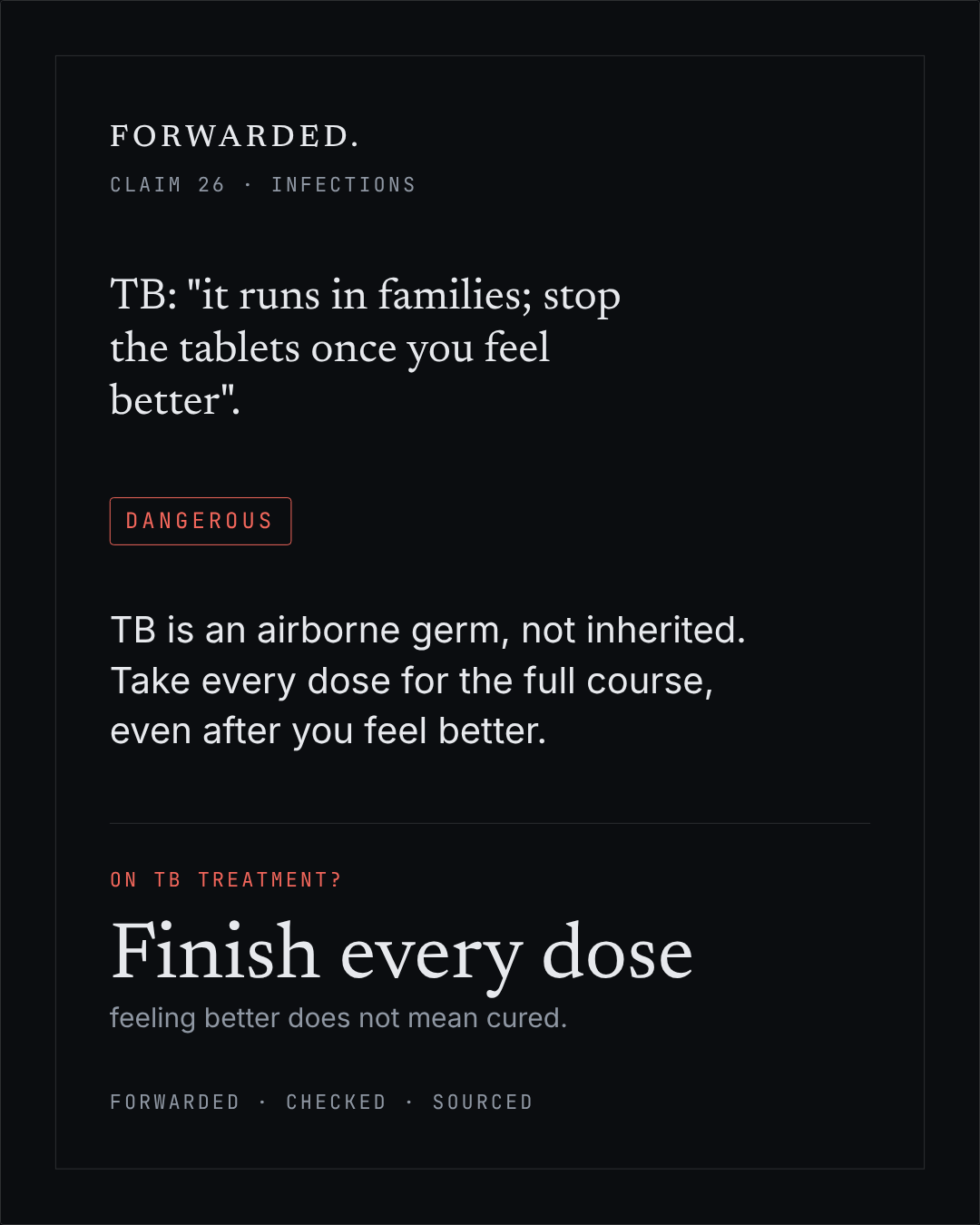
TB: "it runs in families; stop the tablets once you feel better".
As forwarded
"TB runs in families; stop the medicines once you feel better." Other versions say the cough has stopped, so the TB is gone, or that the tablets are too strong and should be taken only when coughing. Some forwards claim TB is a punishment for past deeds.
A belief and behaviour pattern rather than a single viral text. In a survey of 500 adults attending a tertiary hospital in India (2018–2019), 73.6% felt that TB was a genetic disorder, only 12.4% knew it spreads through coughing, and 18% believed TB medicines could be stopped without a health worker's supervision [S1]. Nationally, the share of adults unaware that TB spreads fell from 44.9% in NFHS-3 to 29.6% in NFHS-5, with rural residence linked to lower awareness [S2]. No source opened measured the "punishment" belief. Reach of a specific forward: not available. Belief documented
Verdict
TB is caused by a germ that spreads through the air when someone with lung TB coughs; it is not inherited and not a punishment. It is curable, but only if every dose is taken for the full course, usually six months; feeling better after a few weeks does not mean the germ is gone, and stopping early can bring TB back in a form that is much harder to treat.
What the evidence says
What is right. People usually do feel better within weeks of starting treatment. That is a sign the medicines are working, not that the germ is gone.
A germ, spread through the air. WHO: "TB is spread from person to person through the air"; a person with lung TB releases germs by coughing, sneezing or spitting, and only a few inhaled germs are needed to infect someone; "TB is a treatable and curable disease". [S3] No source supporting heredity or punishment as a cause of TB was located.
The burden. An estimated 10.7 million people fell ill with TB worldwide in 2024 and 1.23 million died. [S4] According to a news report of the same WHO report, India accounted for about 25% of global TB cases, 28% of TB deaths and 32% of multidrug- or rifampicin-resistant TB in 2024. [S5] The Health Ministry reports that TB incidence fell from 237 to 195 per lakh between 2015 and 2023, and that nutrition support under Ni-kshay Poshan Yojana was raised from ₹500 to ₹1,000 a month during treatment. [S6]
Why stopping early is dangerous. WHO lists "patients stopping treatment prematurely" among the causes of drug resistance: "Drug resistance emerges when anti-TB medicines are used inappropriately". Ordinary TB is treated with a "standard 6 month course of 4 antimicrobial drugs", while multidrug-resistant TB has needed 9–12 months or up to 2 years; untreated, about 45% of HIV-negative people with TB die on average. [S3] CDC: "Do not miss any doses and do not stop treatment early"; "It can be very dangerous to stop taking your medicines or not to take all your medicines regularly"; treating drug-resistant TB "is complicated" and can last months or years, with side effects. [S7] India's TB programme training material says every effort must be made to prevent interruptions, and that a person who returns after more than one month off treatment needs drug-susceptibility testing because of the risk of resistance. [S8]
Resistant TB treatment is improving. The Health Ministry reports drug-resistant TB treatment success rising from 68% (2020) to 75% (2022), and a six-month all-oral regimen for multidrug-resistant TB with about 80% success. That is progress, but resistant TB remains harder, longer and riskier to treat than ordinary TB. [S6]
What to do instead
Take every dose for the whole course, usually six months for ordinary TB, even after you feel well. Do not stop or skip because the cough has gone. [S3][S7]
If you think you may have TB, ask at a government health centre; the national TB helpline is 1800-11-6666. [S9]
If side effects make the tablets hard to take, tell the TB health worker or doctor at once rather than stopping; they can manage the side effects. [S7][S8]
If treatment was interrupted, go back to the health centre straight away; after more than a month off, a resistance test is needed. [S8]
Ask about nutrition support during treatment under Ni-kshay Poshan Yojana. [S6]
Cover coughs and keep rooms ventilated; TB spreads through the air. [S3]
Share card
Sources
- S1Shankar M, Ramasubramanian V, Ramakrishnan B. Awareness of tuberculosis in the community: time to rethink strategies. International Journal of Community Medicine and Public Health.Circulation only; not evidence (belief survey)
ijcmph.com/index.php/ijcmph/article/view/5522 - S2Sobagaiah RT et al. Nationwide surveys of awareness of tuberculosis in India uncover a gender gap. Communications Medicine 2024;4.Tier 3
doaj.org/article/6f85a0f406704475a8dd934a315bc877 - S3World Health Organization Regional Office for Africa. Tuberculosis key facts.Tier 2
afro.who.int/news/tuberculosis - S4World Health Organization. Global Tuberculosis Report 2025: TB disease burden.Tier 2
who.int/teams/global-programme-on-tuberculosis-and-lung-health/tb-reports/global-tuberculosis-report-2025/tb-disease-burden - S5Business Standard. WHO Global TB Report 2025: India burden.Circulation only; not evidence
business-standard.com/health/tb-global-report-who-2025-tuberculosis-cases-deaths-india-burden-125111400707_1.html - S6Ministry of Health and Family Welfare. World TB Day 2025 document.Tier 2
static.pib.gov.in/WriteReadData/specificdocs/documents/2025/mar/doc2025324525701.pdf - S7US Centers for Disease Control and Prevention. Treatment for TB disease.Tier 2-equivalent national public health agency
cdc.gov/tb/treatment/index.html - S8National TB Elimination Programme Knowledge Base. Management of patients with treatment interruptions.Tier 2
ntep.in/node/761 - S9Ni-kshay (Central TB Division, MoHFW). About us; national help desk 1800-11-6666.Tier 2 programme page
nikshay.in/Home/AboutUs - S10Pasipanodya JG, Gumbo T. Meta-analysis of self-administered vs directly observed therapy. Clinical Infectious Diseases 2013;57(1):21–31.Tier 1
academic.oup.com/cid/article/57/1/21/278596
Tiers are as graded in the research file. "Circulation only" sources document that a claim circulates and are never cited as evidence. Where a primary paper could not be opened, the page says so in the Honest note.
Reviewed by
Every evidence sentence on this page traces to the sources listed above, but no registered physician has yet signed it off. When one has, their name, registration number and date of review will appear here. Until then, read this page as a sourced guide, not as medical advice: for any symptom, call 108 or 112, or see a doctor.
Corrections
No corrections yet. Write to [email protected].
Was this page helpful?
Counted only as a total for this page; no identifier, no cookie. Something wrong or unclear? Write to us.