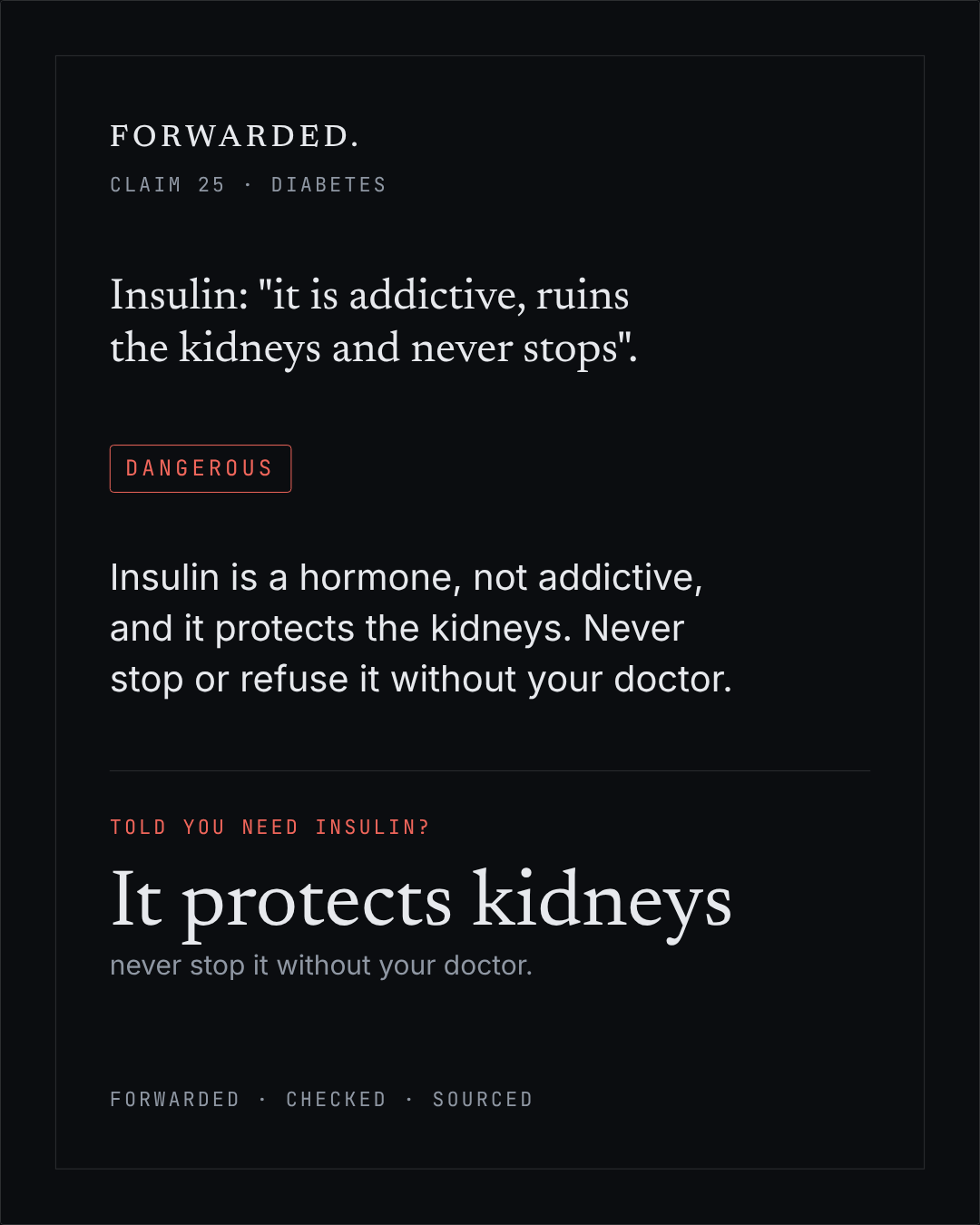
Insulin: "it is addictive, ruins the kidneys and never stops".
As forwarded
"Insulin is addictive and ruins your kidneys; once started it never stops." Variants: "after insulin, only dialysis"; "insulin makes you blind"; "take tablets, never the injection".
A widespread belief more than a single viral text. In an online survey of 309 people in India (66% without diabetes), 58.6% believed insulin caused kidney damage, 60.8% believed that once started it would be needed for life, and 51.5% thought it was started only when diabetes was far advanced; 65% considered it safe [S1]. A diabetes educator's myth list on a patient platform includes "insulin is addictive", "insulin causes complications like blindness and kidney failure" and "once started, never stop" [S2]. Specific forward with URL and reach: not available. Belief documented
Verdict
Insulin is a hormone your body already makes; it is not addictive, and it protects the kidneys and eyes by keeping sugar down. Kidney damage comes from years of high sugar, often because insulin was started too late. People with type 1 diabetes need it for life because their body makes none; many with type 2 need it as the disease progresses, and some use it only for a while. Never stop or refuse insulin without your doctor.
What the evidence says
What is right, partly. Insulin has real risks, mainly low blood sugar and weight gain, and people with type 1 diabetes do need it for life. Those are reasons for education and monitoring, not for refusing it. [S3][S4][S5]
Not addictive. Insulin is a hormone the body itself produces and needs; no evidence of craving, tolerance-seeking or withdrawal in the addiction sense was located. The only harm from stopping it is the disease returning: for people who depend on it, stopping insulin can cause diabetic ketoacidosis, which can be life-threatening and develops over about 24 hours (see Karela, methi and jamun juice for diabetes). India's ICMR guideline names low blood sugar and weight gain as insulin's main drawbacks. [S5]
It protects the kidneys. In the Diabetes Control and Complications Trial (1,441 people with type 1 diabetes, mean 6.5 years), intensive insulin therapy reduced early kidney damage (microalbuminuria) by 39% (95% CI 21–52%) and albuminuria by 54%, eye damage (retinopathy) by 76% in the primary-prevention group, and clinical nerve damage by 60%; the main adverse effect was a two- to three-fold increase in severe low blood sugar. [S3] In type 2 diabetes, UKPDS 33 (3,867 newly diagnosed adults) found intensive control with sulphonylureas or insulin cut small-vessel complications by 25% (95% CI 7–40%) and any diabetes-related endpoint by 12%; insulin was linked to more major low-sugar episodes (1.8% a year vs 0.7%) and about 4 kg weight gain. [S4]
Why people link insulin and kidney failure. It is reverse causation. Insulin is the drug doctors use when the kidneys are already failing, because several tablets are restricted in kidney disease; ICMR lists liver and kidney failure and kidney transplantation among the indications for insulin, and recommends continuous insulin when kidney or eye disease is present. [S5] A clinical review notes that injected insulin is cleared by the kidneys, so doses must come down as kidney function falls to prevent low sugar; that metformin, SGLT2 inhibitors and GLP-1 drugs carry kidney-function limits; and that insulin is preferred in acutely ill or hospitalised patients, including those with advanced kidney disease. [S6] So people who reach dialysis have often been on insulin, but the insulin did not cause it.
"Once started, never stops": partly true, for the wrong reason. In type 1 diabetes "Insulin is the mainstay of therapy", for life, because the body makes none. ICMR calls type 2 diabetes "a progressive disease": tablets tend to become less effective with time, and "insulin use should not be delayed" when they fail. It also recommends insulin "at least for a brief period" at diagnosis when sugar is very high or ketosis is present, and for a time during heart attack, stroke, serious infection, surgery, pregnancy and breastfeeding; insulin can be started without a hospital admission. [S5] Diabetes UK: needing insulin "isn't your fault and it doesn't mean you haven't managed your diabetes well", and "Insulin can be used as a short-term treatment", for example in pregnancy, severe illness or after surgery. [S7] NICE recommends structured education on injection technique, dose adjustment and managing low sugar for everyone starting insulin, and continuing metformin alongside it. [S8]
What to do instead
Never stop insulin on your own, even if you are not eating. Vomiting, deep fast breathing, fruity-smelling breath or drowsiness in someone with diabetes: call 108 or 112 or go to hospital now. [S5] (Ketoacidosis signs: see Karela, methi and jamun juice for diabetes.)
If your doctor recommends insulin, ask for training in injection technique, dose adjustment and what to do if your sugar goes low. [S8]
Have kidney and eye checks regularly, and tell your doctor if kidney function is falling, because insulin doses often need to come down. [S5][S6]
Type 2 diabetes: ask whether insulin is short-term (for illness, surgery, pregnancy or very high sugar at diagnosis) or long-term, and what the plan is to review it. [S5][S7]
Share card
Sources
- S1Vijaya A, Kumar S. Diabetes treatment-related myths and the impact of COVID-19 on diabetes knowledge: an Indian survey. Journal of Diabetes Mellitus 2023;13(2):130–141.Circulation only; not evidence (belief survey)
ntlib.org.cn/asset/detail/0/2031213049510 - S2PatientsEngage. Time to bust some insulin myths and fears.Circulation only; not evidence
patientsengage.com/conditions/time-bust-some-insulin-myths-fears - S3DCCT Research Group. New England Journal of Medicine 1993;329:977–986 (American College of Cardiology trial summary).Tier 3
acc.org/latest-in-cardiology/clinical-trials/2010/02/23/19/01/dcct - S4UK Prospective Diabetes Study Group. UKPDS 33. Lancet 1998;352:837–853.Tier 3
dtu.ox.ac.uk/Manuscripts/DTU230_Abstract.pdf - S5Indian Council of Medical Research. ICMR Guidelines for Management of Type 2 Diabetes.Tier 2
medbox.org/index.php/dl/5e148832db60a2044c2d5206 - S6Iyer SN, Tanenberg RJ. Managing diabetes in hospitalized patients with chronic kidney disease. Cleveland Clinic Journal of Medicine 2016;83(4):301–310.Tier 3
ccjm.org/content/83/4/301.full.pdf - S7Diabetes UK. Insulin and type 2 diabetes.Tier 4-equivalent patient charity page
diabetes.org.uk/guide-to-diabetes/managing-your-diabetes/treating-your-diabetes/insulin/type-2-diabetes - S8NICE NG28. Type 2 diabetes in adults: insulin-based treatments.Tier 2
nice.org.uk/guidance/NG28/chapter/insulin-based-treatments - S9Navaneethan SD et al. Diabetes management in chronic kidney disease: synopsis of the KDIGO 2022 guideline update. Annals of Internal Medicine 2023;176:381–387.Tier 2 synopsis
mcmasteroptimalaging.org/full-article/plus/diabetes-management-chronic-kidney-disease-synopsis-kdigo-2022-clinical-practice-107699
Tiers are as graded in the research file. "Circulation only" sources document that a claim circulates and are never cited as evidence. Where a primary paper could not be opened, the page says so in the Honest note.
Reviewed by
Every evidence sentence on this page traces to the sources listed above, but no registered physician has yet signed it off. When one has, their name, registration number and date of review will appear here. Until then, read this page as a sourced guide, not as medical advice: for any symptom, call 108 or 112, or see a doctor.
Corrections
No corrections yet. Write to [email protected].
Was this page helpful?
Counted only as a total for this page; no identifier, no cookie. Something wrong or unclear? Write to us.