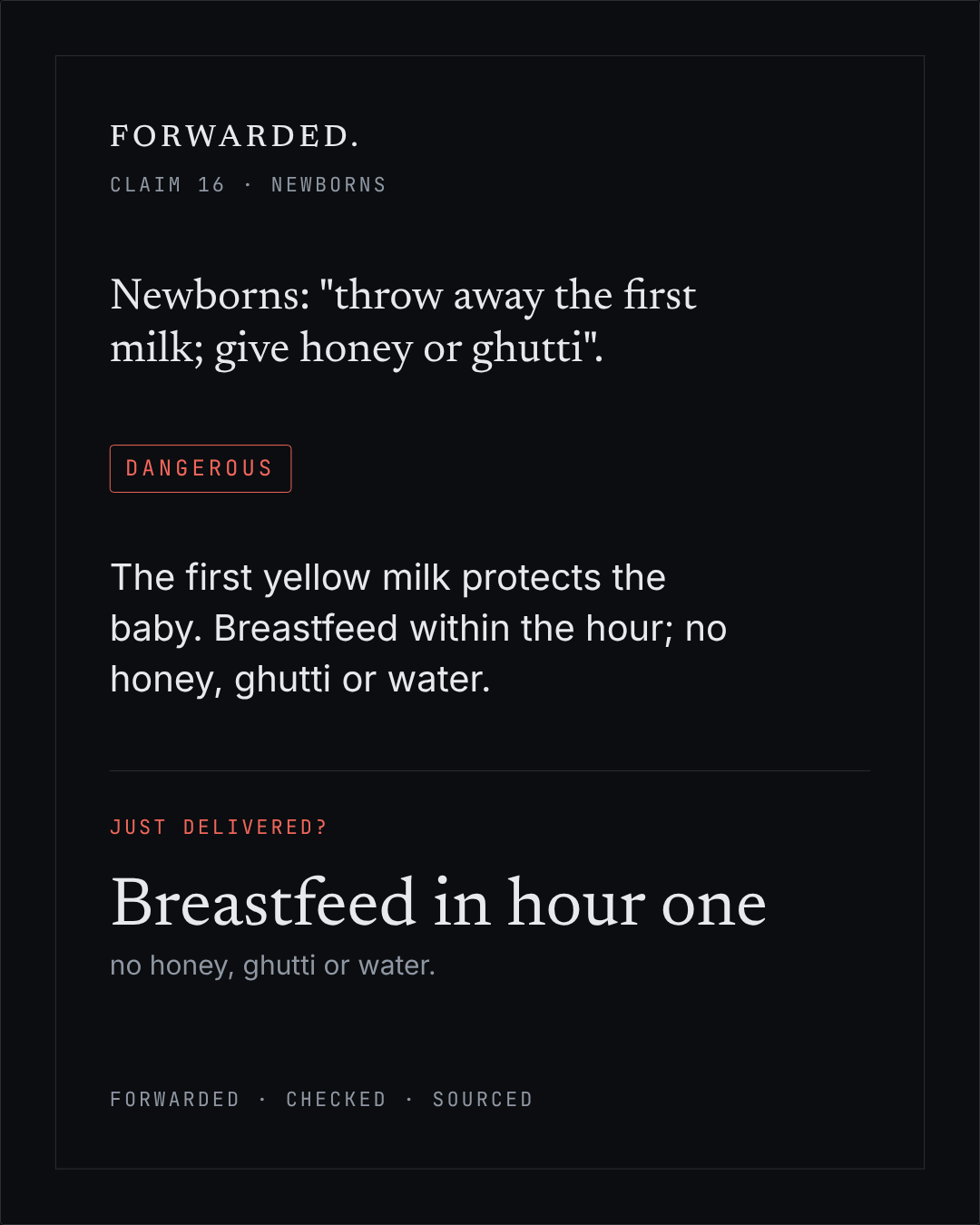
Newborns: "throw away the first milk; give honey or ghutti".
As forwarded
"Discard the first yellow milk; give the newborn honey, ghutti or water first."
A practice passed between families more than a single viral text. A January 2026 newborn-care myth list includes the belief that the first milk is "impure and should be thrown away", that babies need water in hot weather, and gripe water or janam ghutti for digestion [S1]. In India's 2019–21 national family health survey, 84.6% of recent mothers reported no prelacteal feed (anything other than breastmilk in the first three days, "such as honey or gripe water"), implying roughly 15% of babies did get one [S2]; the 15% is inferred, not stated by the authors. Reach of any single forward: not available. Practice documented
Verdict
The first yellow milk (colostrum) is the baby's first protection, not "impure" milk; put the baby to the breast within the first hour, and give nothing else, not honey, ghutti or even water, for six months unless a doctor prescribes it. Honey can cause botulism in babies under one year.
What the evidence says
What is right: the first milk is different. It is yellow and comes before the mature milk, which is why families notice it. That difference is the point: WHO calls colostrum "the perfect food for the newborn". [S3]
The guidance. WHO recommends that "feeding should be initiated within the first hour after birth", with exclusive breastfeeding up to six months. [S3] India's breastfeeding programme: "Feeding first milk (colostrum) protects the baby from diseases"; "No other food or drink, not even water, is usually needed during this period"; staff are told to avoid prelacteal feeds and say "'no' to prelacteals and water", with ORS, vitamin or mineral drops and medicines allowed when medically required. [S4]
Delay costs lives. A systematic review and meta-analysis of five studies (136,047 infants) found that, compared with starting within one hour, starting breastfeeding at 2–23 hours carried a 33% higher risk of newborn death (RR 1.33, 95% CI 1.13–1.56), and starting at 24 hours or later more than doubled it (RR 2.19, 1.73–2.77), with greater delay linked to greater risk; the evidence was rated high quality. [S5] The national survey analysis notes prelacteal feeds can delay breastfeeding and deprive the baby of colostrum, which carries protective antibodies. [S2]
Honey. The bacteria that cause botulism can contaminate honey, so honey, including processed foods containing it, should be kept from babies under one year. Signs of infant botulism include constipation, a weak cry, floppiness, poor feeding and breathing difficulty. [S6] No safety study of ghutti or similar herbal mixtures in newborns was located; under India's breastfeeding programme they count as prelacteal feeds. [S4]
India's starting point. The national breastfeeding guidelines cite survey figures of only 44.6% of mothers starting breastfeeding within one hour and 64.9% of babies exclusively breastfed for six months (2014 survey). [S4]
What to do instead
A newborn who is floppy, feeding poorly, has a weak cry or trouble breathing: go to hospital or call 108 now. [S6]
Put the baby to the breast within the first hour after birth and feed the first yellow milk. [S3][S4]
Give only breastmilk for six months: no honey, ghutti, gripe water, sugar water, animal milk or plain water, unless a doctor prescribes ORS, drops or medicine. [S4]
Never give honey to a baby under one year. [S6]
If breastfeeding is hard, ask the nurse, ASHA worker or doctor for help early rather than giving other feeds. [S4]
Share card
Sources
- S1Business Standard. Newborn care myths: fact check.Circulation only; not evidence
business-standard.com/health/newborn-care-myths-fact-check-india-breastfeeding-colostrum-bathing-crying-126010900274_1.html - S2Dhawan D, Pinnamaneni R, Viswanath K. Association between mass media exposure and infant and young child feeding practices in India (NFHS-5). Scientific Reports 2023;13:19353.Tier 3
nature.com/articles/s41598-023-46734-4.pdf - S3World Health Organization. Breastfeeding (health topic).Tier 2
who.int/vietnam/health-topics/breastfeeding - S4Ministry of Health and Family Welfare. Programme for Promotion of Breastfeeding (MAA): operational guidelines.Tier 2
nhm.hp.gov.in/storage/app/media/Operational_Guidelines-MAA.pdf - S5Smith ER et al. Delayed breastfeeding initiation and infant survival: a systematic review and meta-analysis. PLoS One 2017;12:e0180722.Tier 1
pmc.ncbi.nlm.nih.gov/articles/PMC5528898 - S6NSW Health. Infant botulism factsheet.Tier 4-equivalent government health page
health.nsw.gov.au/Infectious/factsheets/Pages/infant-botulism.aspx
Tiers are as graded in the research file. "Circulation only" sources document that a claim circulates and are never cited as evidence. Where a primary paper could not be opened, the page says so in the Honest note.
Reviewed by
Every evidence sentence on this page traces to the sources listed above, but no registered physician has yet signed it off. When one has, their name, registration number and date of review will appear here. Until then, read this page as a sourced guide, not as medical advice: for any symptom, call 108 or 112, or see a doctor.
Corrections
No corrections yet. Write to [email protected].
Was this page helpful?
Counted only as a total for this page; no identifier, no cookie. Something wrong or unclear? Write to us.