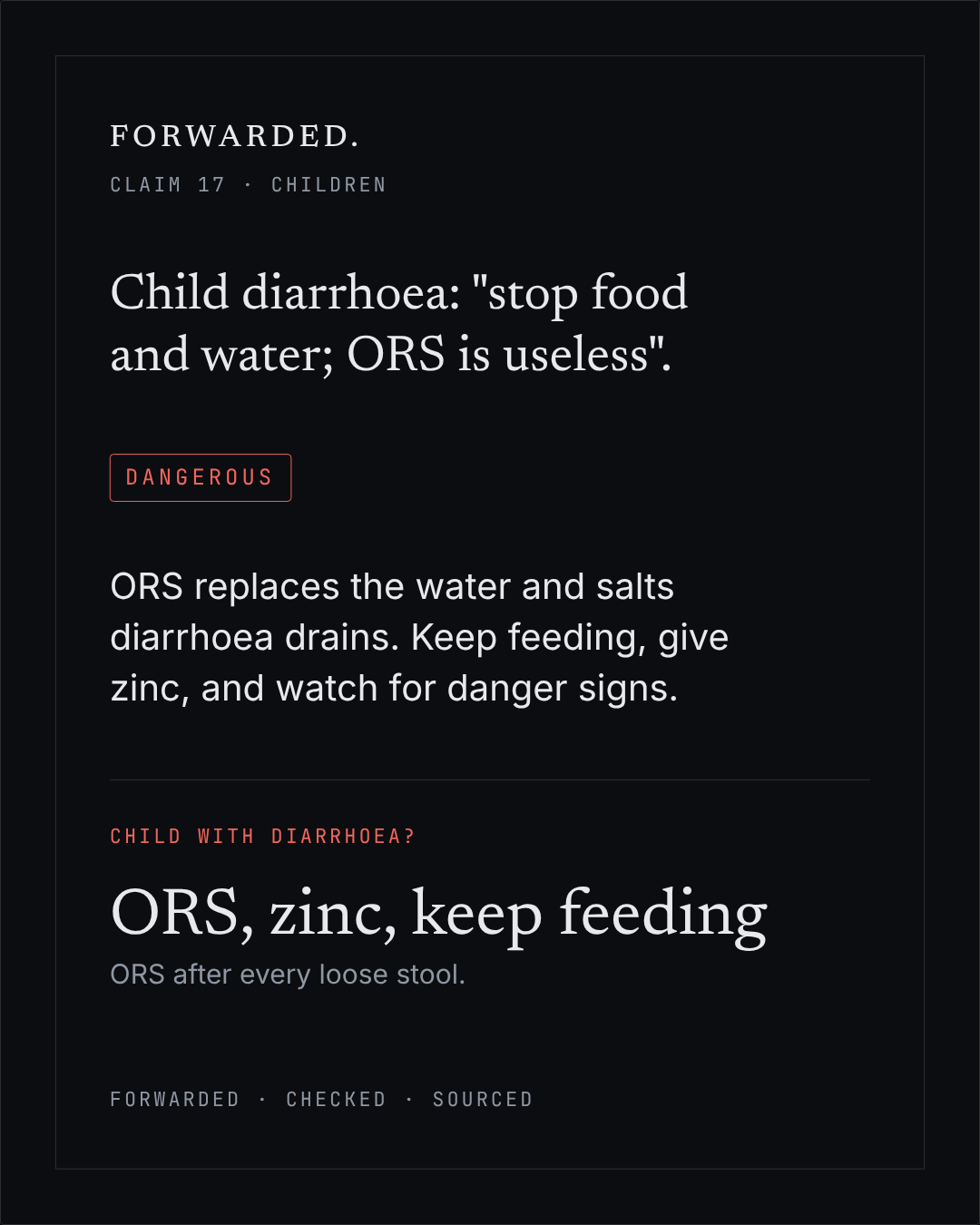
Child diarrhoea: "stop food and water; ORS is useless".
As forwarded
"Stop food and water for a child with diarrhoea; ORS is useless."
Mostly a household belief rather than a single viral text. In a survey of 405 adults in urban Puducherry, 74.6% believed solid and semi-solid food should not be given during diarrhoea, 44.2% that breastfeeding should stop, 33.1% that fluids should stop, and only 53.1% said ORS was useful [S1]. Specific forward with URL and reach: not available. Belief documented
Verdict
Diarrhoea drains a young child's water and salts; ORS replaces them, and feeding, including breastfeeding, should carry on. Give ORS after every loose stool, zinc for 10–14 days, keep feeding, and get help fast for blood in the stool, drowsiness, sunken eyes or a child who cannot drink.
What the evidence says
What is right. A child who is vomiting may manage only small amounts at a time. The answer is small sips often, for example 5–10 ml every 5–10 minutes by spoon or syringe, not stopping. [S6]
The scale. Diarrhoea kills about 443,832 children under five each year and is the third leading cause of death in that age group; WHO calls it "both preventable and treatable". [S2]
ORS works. ORS combines water, salt and sugar, costs pennies per treatment, and replaces the water and salts lost in stool. [S2] A Cochrane review of children admitted with diarrhoea found the current reduced-strength ORS led to fewer unplanned intravenous drips than the older WHO formula (odds ratio 0.59, 95% CI 0.45–0.79), less stool output and less vomiting, with no added risk of low sodium. [S3]
Zinc. A 10–14 day course of dispersible zinc shortens diarrhoea, cutting the length of an episode by 25%, and is linked to a 30% drop in stool volume. [S2] The WHO/UNICEF joint statement made reduced-strength ORS and zinc, alongside breastfeeding and continued feeding, the standard of care. [S4] India's annual STOP Diarrhoea Campaign pre-positions two ORS packets with zinc for every child under five. [S5]
Food and milk. Children should keep eating nutritious food, including breast milk, during an episode. [S2] NHS advice for parents: extra fluids little and often, ORS between feeds or after each watery stool, "Do not stop giving your baby milk", keep breastfeeding and do not dilute formula. [S6]
What to do instead
Child hard to wake, floppy and pale, or struggling to breathe: go to the nearest hospital emergency department or call 108 or 112 now. [S6]
See a doctor the same day for sunken eyes, dry mouth, no tears, much less urine, blood in the stool, constant tummy pain, drowsiness, cold hands and feet, or a child who has stopped drinking or cannot keep fluids down. [S6]
Give ORS after every loose stool, in small sips often if the child is vomiting. [S2][S6]
Give zinc for 10–14 days as advised by the health worker. [S2]
Keep breastfeeding and keep feeding normal food; do not dilute milk or formula. [S2][S6]
Antibiotics are not routinely needed; use them only when a doctor prescribes. [S4]
Share card
Sources
- S1Subramani HP et al. A study of misconceptions about childhood diarrhoea among adults in urban Pondicherry, India. International Journal of Community Medicine and Public Health 3(6).Circulation only; not evidence (belief survey)
ijcmph.com/index.php/ijcmph/article/view/419 - S2World Health Organization. Diarrhoeal disease fact sheet.Tier 2
who.int/news-room/fact-sheets/detail/Diarrhoeal-Disease - S3Hahn S, Kim Y, Garner P. Reduced osmolarity oral rehydration solution for treating dehydration caused by acute diarrhoea in children. Cochrane CD002847.Tier 1
cochranelibrary.com/cdsr/doi/10.1002/14651858.CD002847/pdf/CDSR/CD002847/CD002847_abstract.pdf - S4WHO/UNICEF. Joint statement: clinical management of acute diarrhoea.Tier 2
who.int/publications/i/item/WHO_FCH_CAH_04.7 - S5Medical Dialogues. Union Health Minister launches STOP Diarrhoea Campaign 2024.Circulation only; not evidence
medicaldialogues.in/news/health/union-health-minister-nadda-launches-stop-diarrhoea-campaign-2024-aims-to-attain-zero-child-deaths-130639 - S6NHS Healthier Together. Diarrhoea and vomiting.Tier 4
healthiertogether.nhs.uk/professional/diarrhoea-and-vomiting-10
Tiers are as graded in the research file. "Circulation only" sources document that a claim circulates and are never cited as evidence. Where a primary paper could not be opened, the page says so in the Honest note.
Reviewed by
Every evidence sentence on this page traces to the sources listed above, but no registered physician has yet signed it off. When one has, their name, registration number and date of review will appear here. Until then, read this page as a sourced guide, not as medical advice: for any symptom, call 108 or 112, or see a doctor.
Corrections
No corrections yet. Write to [email protected].
Was this page helpful?
Counted only as a total for this page; no identifier, no cookie. Something wrong or unclear? Write to us.