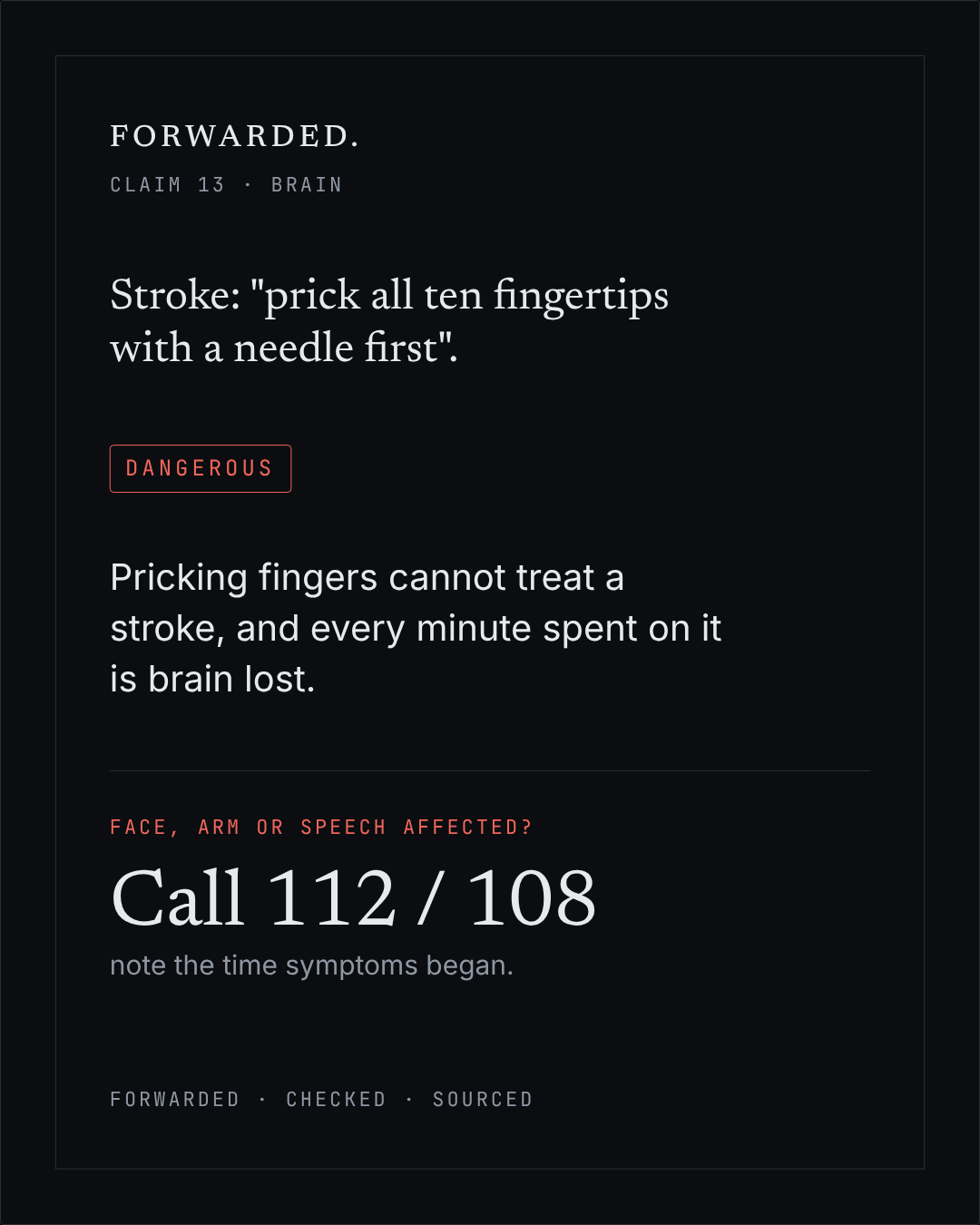
Stroke: "prick all ten fingertips with a needle first".
As forwarded
"Keep a needle at home: for a stroke, prick the fingertips until they bleed before going to hospital." The full set of instructions is deliberately not reproduced here.
A chain message circulating since about 2003 by email, social media, blogs and video, often attributed to a professor or to traditional medicine [S1]; a neurologist rebutted the same text in 2007 [S2]. Reach figure: not available. Reach not available
Verdict
What the evidence says
What is right: it treats stroke as an emergency. Acting immediately is correct; the NHS says to get help straight away. The action the forward prescribes is the wrong one. [S5]
No health organisation recommends it. The fact check found no health body endorsing the method, which is a form of bloodletting, and identified the main danger as delay in calling an ambulance. [S1] No study of fingertip pricking for stroke from a guideline body or major journal was located; the absence of any guideline mention is itself the finding.
Time is the treatment. In a typical untreated large-vessel ischaemic stroke, an estimated 1.9 million neurons and 14 billion synapses are lost each minute, and each untreated hour ages the brain by about 3.6 years compared with normal ageing. [S3]
India's stroke workflow runs on minutes. The ICMR Standard Treatment Workflow lists the BE FAST and FAST warning signs, tells people to "rush to the hospital", requires a CT scan of the head to tell a bleed from a clot, and gives windows of 0–4.5 hours for clot-dissolving treatment and 4.5–24 hours for mechanical clot removal, according to eligibility. Nothing done at home can tell a bleed from a clot; only a scan can. [S4]
The NHS FAST check: face drooping, arm weakness, speech difficulty, time to call the emergency number right away. Get help immediately even if symptoms stop, and "Do not drive yourself to A&E". [S5][S6]
Why it seems to work. Stroke symptoms can fade after a short time, which may make someone seem recovered; the NHS says to get help straight away anyway. [S6] The neurologist's rebuttal notes that such apparent recoveries are often transient attacks that resolve on their own; a recovery after a ritual proves nothing. [S2]
What to do instead
Check FAST: Face drooping, Arm weakness, Speech slurred or confused, Time to call. Call 112 or 108 immediately, even if symptoms fade. [S5][S4]
Note the time symptoms started, or when the person was last seen well; treatment depends on it. [S4]
Get the person to a hospital that can do a CT scan. If you are the patient, do not drive yourself. [S4][S5]
Do not prick, cut or bleed the person, and do not give aspirin (see Aspirin and stroke).
Share card
Sources
- S1That's Nonsense. Can pricking fingertips with a needle help a stroke victim?Circulation only; not evidence
thatsnonsense.com/?p=14608 - S2Novella S (neurologist). Needle nonsense for stroke. NeuroLogica blog.Circulation only; not evidence
theness.com/neurologicablog/needle-nonsense-for-stroke - S3
- S4ICMR / Department of Health Research. Standard Treatment Workflow: image guided management of stroke.Tier 2
icmr.gov.in/icmrobject/uploads/STWs/1726644021_5_image_guided_management_of_stroke.pdf - S5
- S6
Tiers are as graded in the research file. "Circulation only" sources document that a claim circulates and are never cited as evidence. Where a primary paper could not be opened, the page says so in the Honest note.
Reviewed by
Every evidence sentence on this page traces to the sources listed above, but no registered physician has yet signed it off. When one has, their name, registration number and date of review will appear here. Until then, read this page as a sourced guide, not as medical advice: for any symptom, call 108 or 112, or see a doctor.
Corrections
No corrections yet. Write to [email protected].
Was this page helpful?
Counted only as a total for this page; no identifier, no cookie. Something wrong or unclear? Write to us.