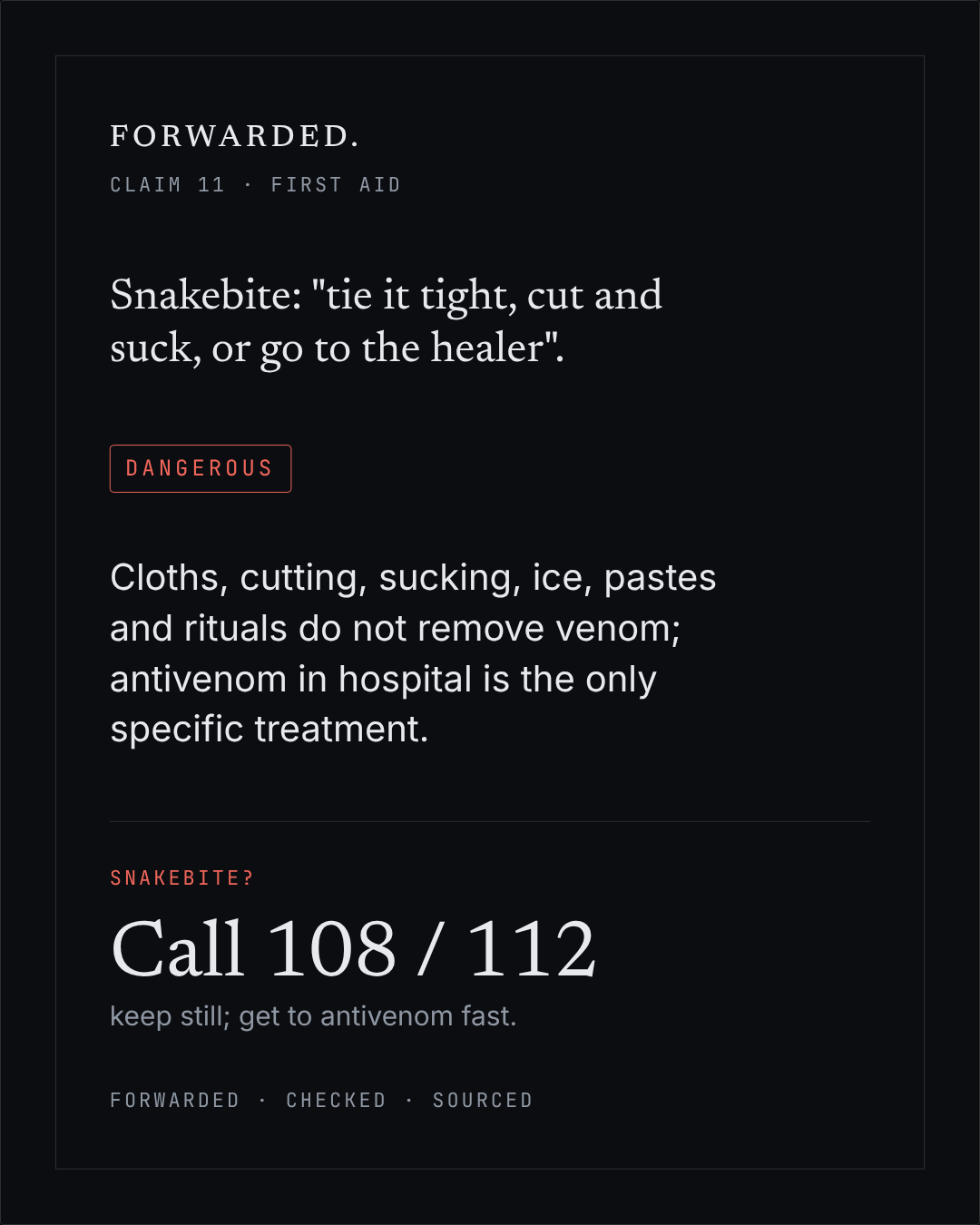
Snakebite: "tie it tight, cut and suck, or go to the healer".
As forwarded
"Tie a tight cloth above the bite, cut it and suck out the venom, or take them to the healer." Variants add rituals, a herbal paste on the wound, a black stone pressed to the bite, or ice.
Circulates as family advice and village practice more than as a single viral text. A 2024 ground report documents families taking bitten relatives to faith healers instead of hospital, a healer sucking a simulated bite wound to "extract venom", and herbal pastes put on wounds [S1]; WHO notes "many victims opting for traditional practices rather than hospital care" [S2]. Specific forward with URL and reach figure: not available. Reach not available
Verdict
What the evidence says
What is right: the urgency. A bite is an emergency, and the instinct to act at once is correct; the action should be getting to a hospital that stocks antivenom. India's Health Ministry guideline also notes that about 70% of snakebites are from non-venomous species, which is why reassurance is part of first aid, and why healers appear to succeed: most of their patients were never envenomed. [S4]
The scale in India. The nationally representative Million Death Study estimated about 1.2 million snakebite deaths in India from 2000 to 2019, about 58,000 a year; about 94% were rural and about 77% happened outside hospital, most at home. [S3] Worldwide, WHO estimates 81,410 to 137,880 snakebite deaths a year and about three times as many amputations or other permanent disabilities. [S2]
Antivenom is the treatment. WHO: "High-quality snake antivenoms are the most effective treatment" to prevent or reverse most venomous effects. [S2] India's guideline: "Anti snake venom treatment is the only specific treatment, it should be given as soon as it is indicated." [S4]
Every step of the forward is rejected. The Health Ministry guideline: "Do not tie tourniquets as it may cause gangrenous limbs"; "Traditional remedies have NO PROVEN benefit in treating snakebite"; black stones, scarification and herbal or alternative therapy are to be discarded because they delay treatment; and the wound should not be cut, sucked, rubbed, tattooed, massaged, iced, cauterised or treated with herbs or chemicals. [S4]
International first-aid pages agree. Mayo Clinic: do not use a tourniquet or apply ice, do not cut the bite or try to remove the venom, keep the limb still, and call emergency services right away. [S5] NHS: "do not try to suck or cut the poison (venom) out of the bite", do not tie anything tightly around the bitten area, and do not take aspirin or ibuprofen. [S6]
What to do instead
Call 108 or 112 and get the person to the nearest hospital or health centre with antivenom, as fast as possible. The person should not walk, run or drive themselves. [S4][S5][S6]
Keep the person calm and still, and keep the bitten limb still like a fracture, without blocking blood flow. Lay them on their side and give nothing by mouth. [S4]
Remove rings, bangles, anklets, watches, shoes and tight clothing near the bite before swelling starts. [S4][S5]
Do not tie a tight cloth or tourniquet, cut, suck, or apply ice, herbal paste, chemicals or a stone, and do not wait for a ritual. [S4][S5][S6]
Do not try to catch or kill the snake, and do not give aspirin or ibuprofen for pain. [S4][S6]
Share card
Sources
- S1ThePrint. Ground report: snakebites kill more Indians than malaria and dengue.Circulation only; not evidence
theprint.in/ground-reports/snakebites-kill-more-indians-than-malaria-dengue-blame-the-urban-rural-divide/2229766 - S2World Health Organization. Snakebite envenoming fact sheet.Tier 2
who.int/en/news-room/fact-sheets/detail/snakebite-envenoming - S3Suraweera W et al. Trends in snakebite deaths in India from 2000 to 2019 in a nationally representative mortality study. eLife 2020;9:e54076.Tier 3
elifesciences.org/articles/54076 - S4Ministry of Health and Family Welfare. Standard Treatment Guidelines: Management of Snake Bite.Tier 2
ncdc.mohfw.gov.in/uploads/pdf/Standard-Treatment-Guidelines-for-Management-of-Snake-Bite.pdf - S5Mayo Clinic. Snakebites: first aid.Tier 4
mayoclinic.org/first-aid/first-aid-snakebites/basics/art-20056681 - S6
Tiers are as graded in the research file. "Circulation only" sources document that a claim circulates and are never cited as evidence. Where a primary paper could not be opened, the page says so in the Honest note.
Reviewed by
Every evidence sentence on this page traces to the sources listed above, but no registered physician has yet signed it off. When one has, their name, registration number and date of review will appear here. Until then, read this page as a sourced guide, not as medical advice: for any symptom, call 108 or 112, or see a doctor.
Corrections
No corrections yet. Write to [email protected].
Was this page helpful?
Counted only as a total for this page; no identifier, no cookie. Something wrong or unclear? Write to us.